
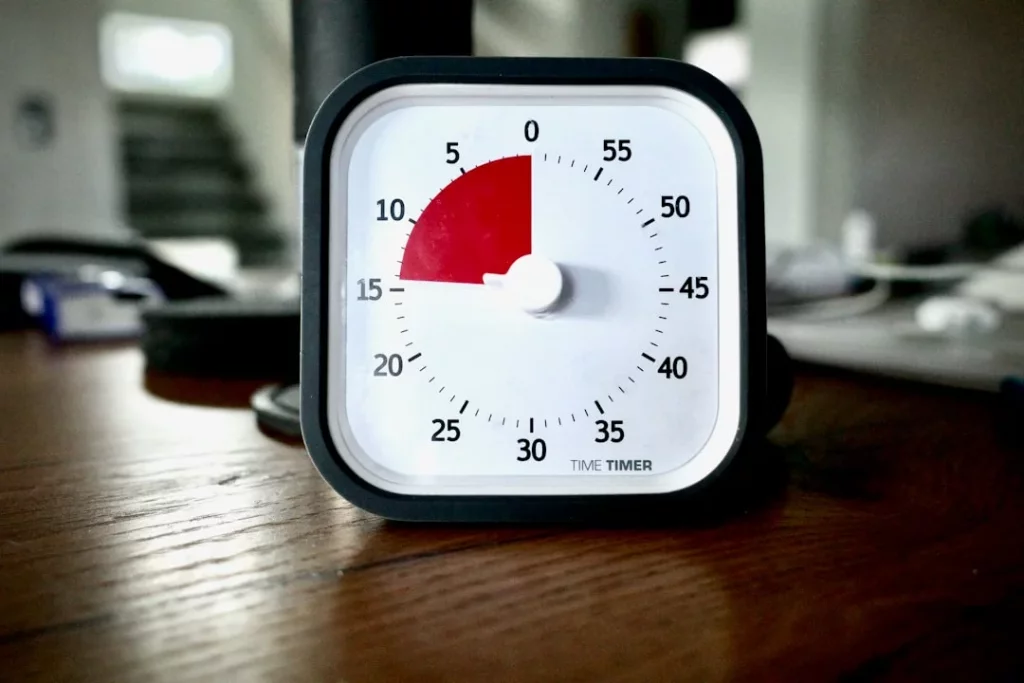
You probably don’t need more motivation. You need a smaller starting point. The 5-minute rule for procrastination works because it lowers the bar: instead of telling yourself to finish the whole task, you commit to doing it for just five minutes. Pair that with micro goals — tiny, concrete actions like “open the document” or “write one sentence” — and starting gets a lot less dramatic.
Sound familiar? You know what to do, you even want the result, but your brain still treats “start” like it’s a threat. And if task initiation is where you get stuck, it’s worth also reading our guide on executive dysfunction vs procrastination and our 2-minute rule guide, because these problems overlap — but they’re not the same thing.
Here’s the key distinction. The 5-minute rule for procrastination is a short time commitment to begin; micro goals are the tiny steps inside that time block. That’s different from the 2-minute rule, which focuses on tasks you can do almost immediately, and different from SMART goals, which are better for planning outcomes than for getting yourself to begin when you feel stuck.
Research on behavioral activation and action-taking suggests that small, doable behaviors can help reduce avoidance and build momentum; even the basic idea behind behavioral activation in psychology points in that direction. So here’s the deal: this article will show you exactly what micro goals for procrastination are, how to break tasks into micro goals, and when to use the 5-minute rule versus other “just start” methods.
You’ll also get practical micro goals examples for studying, work tasks, writing, cleaning, and ADHD overwhelm. No vague “just try harder” advice. I’m a software engineer and self-taught learner who built FreeBrain tools around focus and follow-through, and I’ve found that when people stop chasing motivation first and shrink the start instead, they actually move.
📑 Table of Contents
- Why starting feels so hard
- The 5-minute rule for procrastination
- How to break tasks into micro goals
- Real-world examples that actually help
- Mistakes, micro procrastination, and next steps
- Frequently Asked Questions
- What are micro goals for procrastination?
- What is an example of a micro goal?
- How do you break a task into micro goals?
- How do micro goals differ from the 2-minute rule?
- What is a smart goal for procrastination?
- What is micro procrastination?
- What are micro goals for studying when overwhelmed?
- What is the 5 4 3 2 1 rule for procrastination?
- Conclusion
Why starting feels so hard
So here’s the deal: the 5-minute rule for procrastination means committing to a task for just five minutes, while micro goals mean shrinking that task into something visible and low-friction, like opening the document and writing one rough sentence. If task initiation keeps tripping you up, it also helps to read FreeBrain’s 2-minute rule guide and our breakdown of executive dysfunction vs procrastination.
Most procrastination isn’t simple laziness. Research in psychology often links it more to emotion regulation and task aversion than to bad character, and the American Psychological Association’s overview of procrastination reflects that broader view. I’m a software engineer, not a psychologist, but after building FreeBrain tools for study workflows and deep work tasks, I’ve seen the same pattern again and again: people don’t avoid work because they’re careless; they avoid what feels unclear, heavy, or threatening.
The real problem isn’t always motivation
People often wait to feel ready. But wait—readiness usually shows up after you start, not before.
Task initiation is the gap between intending to act and actually beginning. And this is where many students and professionals get stuck. “Write essay” feels vague and heavy; “open the doc and list 3 bullet points” feels startable. That’s how to stop procrastinating with small steps: reduce emotional resistance before you demand effort.
- Overwhelm: the task feels too big
- Uncertainty: you don’t know the first move
- Perfectionism: you want a good start, not a real start
- Delayed reward: the payoff feels far away
What micro goals mean in plain English
What are micro goals for procrastination? Tiny, observable actions that move the real task forward. Micro goals meaning, in practice, is simple: the step should be small enough to begin in under 60 seconds and clear enough that you can’t really “overthink” it.
Personally, I think this is the part most people get wrong. A normal to-do says “study biology.” A micro goal says “open chapter 4, read one heading, and highlight two terms.” If you need a cue-based start routine, FreeBrain’s deep work warm-up ritual helps reduce friction even more. We’ll compare these tiny actions with the 2-minute rule, the 5-minute rule for procrastination, and SMART goals in the next sections.
When small steps aren’t enough on their own
Micro goals help many people start, but they aren’t a cure-all for ADHD, anxiety, depression, or severe executive dysfunction. Evidence summarized by the NCBI overview of executive dysfunction shows that persistent starting problems can be tied to deeper cognitive or mental health issues.
If your starting problems are frequent, severe, or affecting school, work, sleep, or daily life, talk to a qualified professional, therapist, coach, or student support service. Which brings us to the next question: how do you turn this idea into an actual method you can use today?
The 5-minute rule for procrastination
If starting is the hardest part, lower the price of starting. The 5-minute rule for procrastination means you commit to five minutes of real work—not planning, color-coding, or “getting ready.”
That distinction matters. When people say they “worked” but only reorganized their desk, they never crossed the action barrier. And if your struggle feels deeper than delay, this guide on executive dysfunction vs procrastination can help you tell the difference.
📋 Quick Reference
Goal: Start, not finish.
Rule: Do 5 minutes of visible action.
Examples: Read 1 page, write 1 rough paragraph, review 5 flashcards, clean 1 shelf.
Why it works: It lowers resistance, reduces uncertainty, and creates momentum.
What five minutes actually does
The goal isn’t to finish in five minutes. It’s to cross the starting barrier through a small, concrete action, which overlaps with ideas from behavioral activation and implementation intentions in psychology.
Examples help. Read one page. Clean one shelf. Write one ugly paragraph. Review five flashcards. Many people keep going once they begin, but stopping after five still counts because it builds trust: you did what you said you’d do.
From experience, after building planning and study tools, the biggest drop-off usually happens before the first visible action—not in the middle.
Micro goals vs 2-minute rule vs SMART goals
| Method | Purpose | Best use | Example | Common mistake |
|---|---|---|---|---|
| 2-minute rule | Remove setup friction | Tiny tasks or starter actions | Open notes app | Using it for big tasks |
| 5-minute rule | Time-box the start | Avoided tasks | Study chemistry for 5 minutes | Spending 5 minutes preparing |
| Micro goals | Shrink the task | Overwhelm and unclear projects | Answer question 1 only | Making the “small” step too big |
| SMART goals | Plan outcomes | Weekly targets | Finish chapter summary by Friday 4 p.m. | Using planning instead of action |
So what is a smart goal for procrastination? It’s a clear weekly target, not your first move. For the tiny starter move, compare this with our 2-minute rule guide. And for the planning side, the broader logic fits the SMART criteria framework.
When to combine them
These methods work better together than alone. Quick sidebar: this is the part most people miss.
- Pick a cue
- Use a tiny setup action
- Set a 5-minute timer
- Do the next visible step
Work example: after coffee, open the draft, set a timer, and write the first bullet. Study example: sit down, open flashcards, set five minutes, and review one small chunk—our guide to chunk information for students helps with that.
And if you want the rule to stick, pair it with a simple cue and start routine like this deep work warm-up ritual. Next, I’ll show you how to break any avoided task into micro goals that are almost impossible to resist.
How to break tasks into micro goals
The 5-minute rule for procrastination gets you moving. Now you need a way to decide what, exactly, to do in those five minutes.
If starting feels weirdly hard, that doesn’t always mean laziness. Sometimes it’s unclear task design, and sometimes it overlaps with executive dysfunction vs procrastination. Either way, micro goals fix the entry point.
How to turn a big task into a startable micro goal
- Step 1: Name the avoided outcome
- Step 2: Find the first visible action
- Step 3: Shrink it until resistance drops
- Step 4: Add a time box and cue
- Step 5: Decide the next step before you stop
Step 1: Name the avoided outcome
Start with the real target: submit the report, start revision, clean the kitchen, reply to the insurance email. Vague goals create vague resistance. That’s the first rule of task breakdown if you want to know how to break a big task into micro goals.
Step 2: Find the first visible action
Make it observable. Good examples: open the file, put the textbook on the desk, write the title, collect dishes from one room. Not “think about the essay.” If you’re comparing methods, the 2-minute rule guide is great for ultra-small starts, while the 5-minute rule for procrastination gives you slightly more room to build momentum.
Step 3: Shrink it until resistance drops
Still avoiding it? Shrink again. “Outline the essay” becomes “write three messy bullets.” “Study chapter 4” becomes “answer one practice question.” Research on implementation intentions points to the value of specific action plans.
Step 4: Add a time box and cue
Use: “When it is [time/cue], I will [tiny visible action] for [5 minutes or one micro step] in [location].” Good cues: after coffee, after class, at 7:30 p.m., after opening your laptop. Pair it with a short deep work warm-up ritual to cut friction fast.
Step 5: Decide the next step before you stop
This is the part most people miss. Before stopping, write the next action: draft intro sentence, solve question 2, email manager with 2 options. That reduces restart friction, which fits what research from the NCBI overview of procrastination suggests about emotion, avoidance, and follow-through.
- Paper example: open doc
- paste prompt
- write title
- list 3 source questions
- find 1 source
- save citation
- write 3 bullets
- draft 1 sentence
- note next step
Want a practical place to map these out? Use the undated weekly planner template and assign one micro step per day. Next, I’ll show real-world examples that actually help.
Real-world examples that actually help
Breaking tasks down is the idea. This is what it looks like in real life. The 5-minute rule for procrastination works best when your first move is tiny, visible, and obviously connected to the real task.

Studying when you feel behind
If you’re overwhelmed, don’t “study biology.” Start smaller. Use chunk information for students to turn one assignment into units, then place those units inside a weekly study schedule.
- Too big: review the chapter → Better: read 1 page and mark 2 key terms
- Memorize everything → review 5 flashcards
- Finish problem set → solve 1 problem
- Understand lecture → highlight 1 confusing concept
- Write notes → write 1 summary sentence
- Prepare for exam → set up 1 practice quiz
- Catch up on class → open slides and label 3 topics
- Study math → copy the formula sheet onto one page
- Read article → annotate the abstract only
Work, writing, and deep-focus tasks
Same pattern at work. Instead of “finish report,” try: open the doc; write 1 rough heading; review 1 chart; draft 1 ugly sentence; list 3 blockers; open the repo and read the last commit; reply to 1 priority email; rename the file; write the next question to answer. Personally, I think these are the best micro goals for work procrastination because they lower startup cost without faking progress.
And here’s the kicker — one micro goal often gets you into a larger 60-minute deep work block. From experience, users usually do better when the first step feels almost embarrassingly small.
Cleaning, admin, and life tasks
- Clean the apartment → collect trash from 1 room
- Do the dishes → wash 5 dishes
- Fix finances → open the bill and note the due date
- Do laundry → put 1 load in
- Handle paperwork → find the form and fill section 1
- Sort email → archive 10 messages
- Get healthcare sorted → book the appointment
- Tidy desk → clear one 12-inch square
What is an example of a micro goal? A step that creates real progress, not busywork.
For ADHD overwhelm and decision fatigue
When starting feels weirdly hard, reduce friction first. Leave the tab open, put materials on the desk, write one visible next step, start a timer, remove one distraction. Research on executive functions and task initiation helps explain why fewer decisions matter; see the NCBI overview of executive function.
This is educational, not medical advice. If executive dysfunction or overwhelm is persistent and impairing, read more on executive dysfunction vs procrastination and consider talking with a qualified professional. Next, let’s cover the mistakes that make micro goals backfire.
Mistakes, micro procrastination, and next steps
Examples help. But the real win comes from catching the sneaky mistakes that make the 5-minute rule for procrastination look useful while nothing meaningful moves.
That’s where micro procrastination shows up. It’s the tiny, low-value stuff that feels productive but mostly functions as avoidance behavior.
How to spot fake progress
So what is micro procrastination, exactly? It’s renaming files instead of drafting the first paragraph, watching productivity videos instead of solving one problem, or making a perfect plan instead of sending the email.
Use a simple filter: does this action move the real task forward in the next 5 minutes? If yes, keep it. If not, it’s probably delay dressed up as preparation.
- Rename files → Draft 3 sentences
- Research apps → Open the document and write the heading
- Reorganize notes → Answer one practice question
Common mistakes that make small steps fail
This is the part most people get wrong. The step is still too big, or it’s setup work instead of real work, or they stop without defining the next action.
Three fixes matter: shrink further, add a cue, and write the next step before you quit. And if perfectionism keeps inflating your “small” step, read our guide to stop perfectionism procrastination.
Quick reference and 7-day reset
📋 Quick Reference
- Choose one avoided task
- Define one visible action
- Set a 5-minute timer
- Stop by writing the next step
- Review for 2 minutes at night
Try this for 7 days: one avoided task per day, one micro goal, one 5-minute start, one written next step, one short evening review. That’s how to use micro goals for procrastination in real life.
The goal of the 5-minute rule for procrastination isn’t perfect motivation. It’s easier starting, better follow-through, and habit formation through repeated friction reduction. Next, let’s answer the questions people still get stuck on.
Frequently Asked Questions
What are micro goals for procrastination?
What are micro goals for procrastination? They’re tiny, specific actions that move a real task forward instead of keeping it vague in your head. The point is to make the first step so clear and easy that your brain stops treating the task like a threat. A good example is: “open the document and write one rough sentence” — not “work on essay,” which is too broad to start.

What is an example of a micro goal?
What is an example of a micro goal? For studying, it could be “review 5 flashcards”; for work, “draft the first bullet point of the report”; for home tasks, “put 3 dishes in the dishwasher.” Notice the pattern: each one is observable and tied to the real outcome, not just prep work like color-coding notes or renaming files. If you’re using the 5-minute rule for procrastination, these small actions are often the best place to begin.
How do you break a task into micro goals?
If you’re wondering how to break tasks into micro goals, use a simple 5-step method: pick the real task, define the smallest visible action, shrink it until resistance drops, attach a cue, and give it a short time box. For example, instead of “study biology,” try “after I sit at my desk, I’ll answer one practice question for 5 minutes.” And yes, that last part matters — a cue plus a time limit makes starting much easier than relying on motivation alone.
How do micro goals differ from the 2-minute rule?
Micro goals vs 2-minute rule comes down to scope. The 2-minute rule is best for tasks that truly take about two minutes or for a tiny setup action, while micro goals are a broader way to break larger projects into doable pieces that still create progress. The two work well together: you might use the 2-minute rule to open your notes, then a micro goal to solve one problem or draft one paragraph.
What is a smart goal for procrastination?
What is a smart goal for procrastination? A SMART goal is specific, measurable, achievable, relevant, and time-bound. It helps you define the outcome clearly, like “finish 20 practice questions by 7 p.m. on Thursday,” while micro goals help you start the next action, like “solve question 1 now.” Personally, I think this is the part most people miss: SMART goals are great for planning, but they don’t always remove the friction of beginning.
What is micro procrastination?
What is micro procrastination? It’s when you do small, low-value actions that feel productive but delay meaningful work. Common examples include reorganizing notes instead of studying, tweaking formatting instead of drafting, or reading about productivity instead of actually starting. If that sounds familiar, the fix is to switch from fake progress to a real micro step — the same kind of action used in the 5-minute rule for procrastination.
What are micro goals for studying when overwhelmed?
Micro goals for studying when overwhelmed should be so small that you can start before your stress ramps up. Good examples are: review 5 flashcards, solve 1 problem, summarize 1 page, or explain 1 concept out loud in 2 sentences. These work even better when you pair them with a weekly plan and chunking, like the study systems we use in FreeBrain’s planning content and tools, including FreeBrain study resources.
What is the 5 4 3 2 1 rule for procrastination?
What is the 5 4 3 2 1 rule for procrastination? It’s a different method from the 5-minute rule for procrastination and usually means counting down — 5, 4, 3, 2, 1 — to interrupt hesitation and trigger immediate action. It can help when you’re stuck in overthinking and need to begin the first physical movement, like standing up, opening your laptop, or picking up your textbook. For a broader overview of procrastination patterns and behavior change, the American Psychological Association has useful background on why people delay tasks.
Conclusion
Here’s the practical version. Pick one task you’ve been avoiding, lower the bar until it feels almost too easy, and commit to just five minutes. Then turn that task into micro goals so small they’re obvious: open the document, write one sentence, solve one problem, review one flashcard set. And if you catch yourself doing “productive” side tasks instead of the real one, stop and ask: does this move the work forward, or is it just micro procrastination in disguise? That’s why the 5-minute rule for procrastination works so well — it helps you beat the hardest part: starting.
And yes, some days this will still feel harder than it “should.” That’s normal. Motivation is unreliable, but small actions aren’t. Personally, I think this is the part most people miss: you do not need to feel ready before you begin. You need a starting point that feels safe enough to do now. One tiny win today can make tomorrow’s work lighter, and those small starts add up faster than you’d think.
If you want to keep building momentum, explore more practical tools and guides on FreeBrain.net. You might start with How to Stop Procrastinating When Studying for study-specific tactics, or Spaced Repetition if you want an easier way to turn small study sessions into long-term memory. Use the 5-minute rule for procrastination today, choose one micro goal, and get moving before your brain talks you out of it.