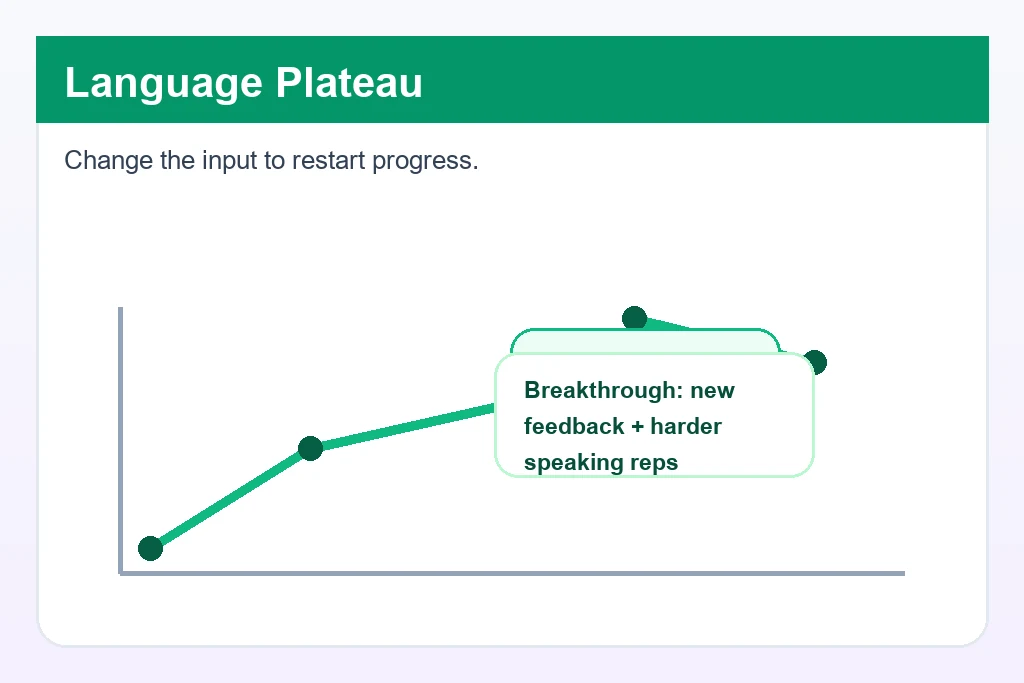
If you’re wondering how to get out of plateau in language learning, the short answer is this: you’re probably not bad at languages, and you probably don’t need more motivation. Most of the time, how to get out of plateau in language learning comes down to fixing a mismatch between what you’re practicing and the next skill your brain actually needs to build.
A language plateau usually shows up when your old study methods stop producing visible gains. And yes, that’s common — especially during the intermediate stage, when you can understand a lot but still feel slow, awkward, or weirdly stuck. The fix? Seven moves: diagnose the bottleneck, narrow the skill target, increase comprehensible input, add more output with feedback, deepen vocabulary encoding, measure progress weekly, and follow a 30-day recovery plan.
Sound familiar? You study, but your speaking still stalls. You listen to podcasts, but real conversations still blur together. You know hundreds of words, yet when you need them, nothing comes out.
That frustrating gap isn’t random. Research on second-language acquisition has long pointed to the role of input, output, feedback, and repeated exposure — not just raw study time. So if you’re searching how to get out of plateau in language learning, the better question is: which part of your system has stopped adapting?
In this article, you’ll get a practical way to answer that fast. I’ll show you how to break a language learning plateau with a simple diagnostic framework, a cause-vs-fix table, and a measurable 30-day reset plan for speaking, listening, vocabulary, and grammar. We’ll also look at the balance between study and exposure, including when an immersion language learning guide can help, and why deeper recall methods like these elaborative rehearsal examples matter when vocabulary growth stalls.
Personally, I think this is the part most people get wrong. They try harder instead of practicing smarter. I’m a software engineer, not a linguist, but after building FreeBrain tools and testing learning systems on myself, I’ve found that how to get out of plateau in language learning is usually less about effort and more about targeting the right constraint at the right time.
📑 Table of Contents
- What a language learning plateau is — and how to get out of plateau in language learning fast
- Why you’re stuck: self-assessment, causes, and mistakes that keep a language learning plateau going
- How to break a language learning plateau in 7 steps
- Fixes by plateau type: speaking, listening, vocabulary, grammar — plus a 30-day recovery plan
- Frequently Asked Questions
- What is a language learning plateau?
- How do I get out of a plateau in language learning?
- Why am I not improving in language learning even though I study a lot?
- How long does a language plateau last?
- How do you fix a speaking plateau in language learning?
- How do you fix a listening plateau in language learning?
- Conclusion
What a language learning plateau is — and how to get out of plateau in language learning fast
If your early gains have slowed, that doesn’t mean you’ve stopped learning. A language learning plateau is a period where visible progress slows because your current method no longer matches the next skill your brain needs to build. For more on learning and study skills, see our learning and study skills guide.
A quick definition of a language learning plateau
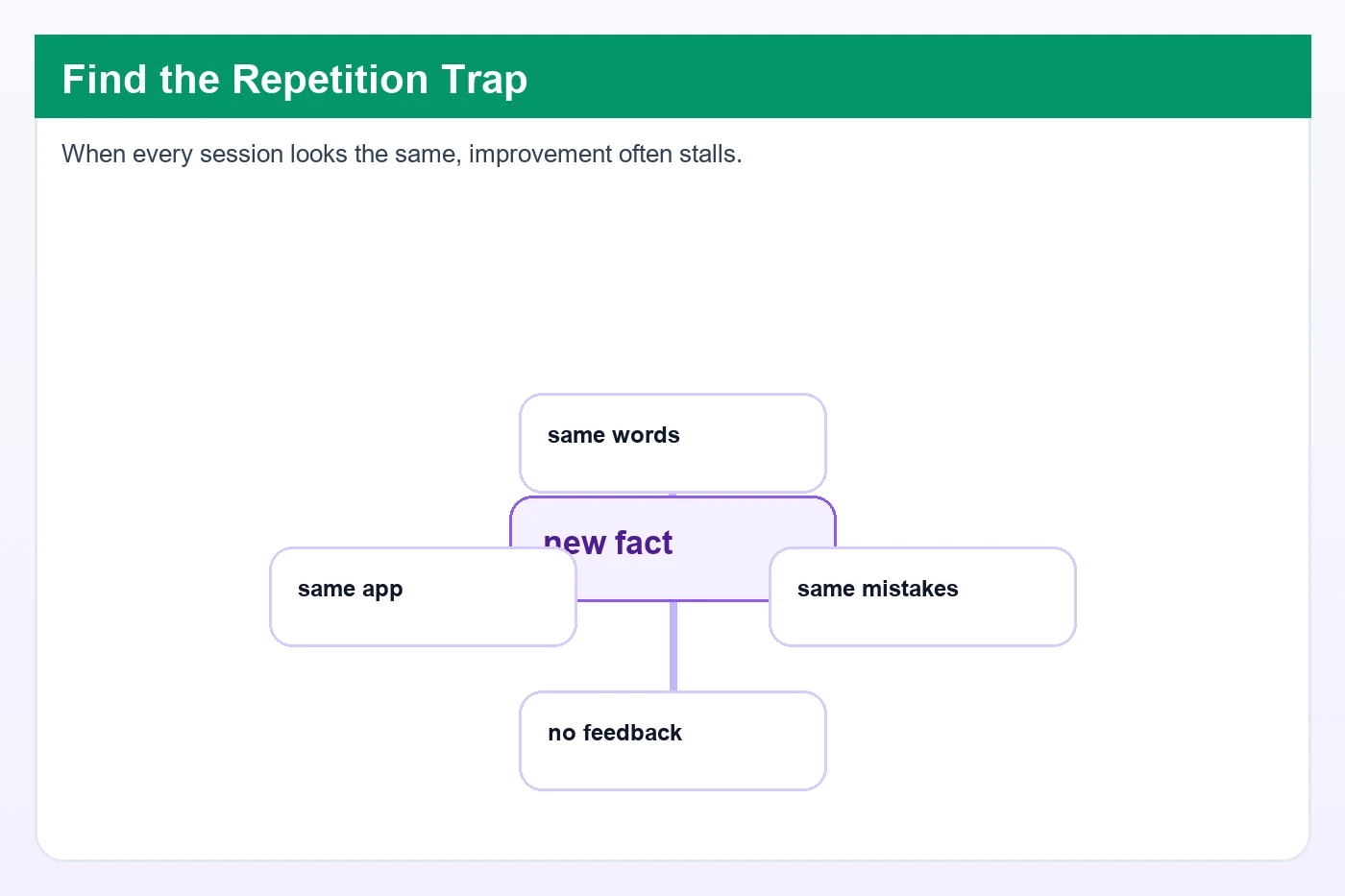
So here’s the deal. If you’re wondering how to get out of plateau in language learning, start with the right definition: a plateau usually means your study loop is outdated, not that your ability has peaked. That’s especially true in the intermediate language plateau, when you shift from recognizing words to recalling them fast enough to speak.
What is a language learning plateau in plain English? It’s when progress feels flat because the task changed. You may still understand textbook grammar, yet freeze in conversation, miss natural-speed audio, or forget words you “know.” That’s slow visible progress, not true stagnation.
This is common. Personally, I think most self-taught learners hit this phase when passive exposure stops being enough. If you want a better balance of input and active use, start with FreeBrain’s immersion language learning guide.
The 7-step quick answer
Want the short version of how to get out of plateau in language learning fast? Use this sequence:
- Diagnose the bottleneck.
- Narrow the goal.
- Raise difficulty by about 10-15%.
- Add daily output.
- Use retrieval plus spaced repetition.
- Tighten feedback.
- Track weekly outcomes.
And yes, immersion helps, but mostly when paired with attention, correction, and active production. Research on retrieval practice and long-term learning supports this pattern, and evidence on sleep and memory consolidation from NCBI Bookshelf helps explain why gains often appear after recovery, not during cramming. We’ll turn this into a practical 30-day plan later.
From experience: why plateaus often show up after early progress
I’m a self-taught learner and software engineer, and after building FreeBrain tools, I keep seeing the same pattern: early gains come from broad exposure, but later gains require targeted correction. Many learners who feel stuck in language learning overestimate input and underestimate retrieval, output, and explanation-based practice. That’s where tools like elaborative rehearsal examples and this guide on Feynman technique effectiveness become useful.
But wait. Progress also depends on language distance, prior exposure, time available, and your environment. Which brings us to the next question: what exactly is keeping your language learning plateau going?
Why you’re stuck: self-assessment, causes, and mistakes that keep a language learning plateau going
You know what a plateau feels like. Now the useful question is how to get out of plateau in language learning when the problem isn’t motivation, but a hidden bottleneck. Very often, the answer isn’t “study more.” It’s “diagnose better,” especially if you’ve been relying on passive exposure or an immersion language learning guide without enough active use and feedback.
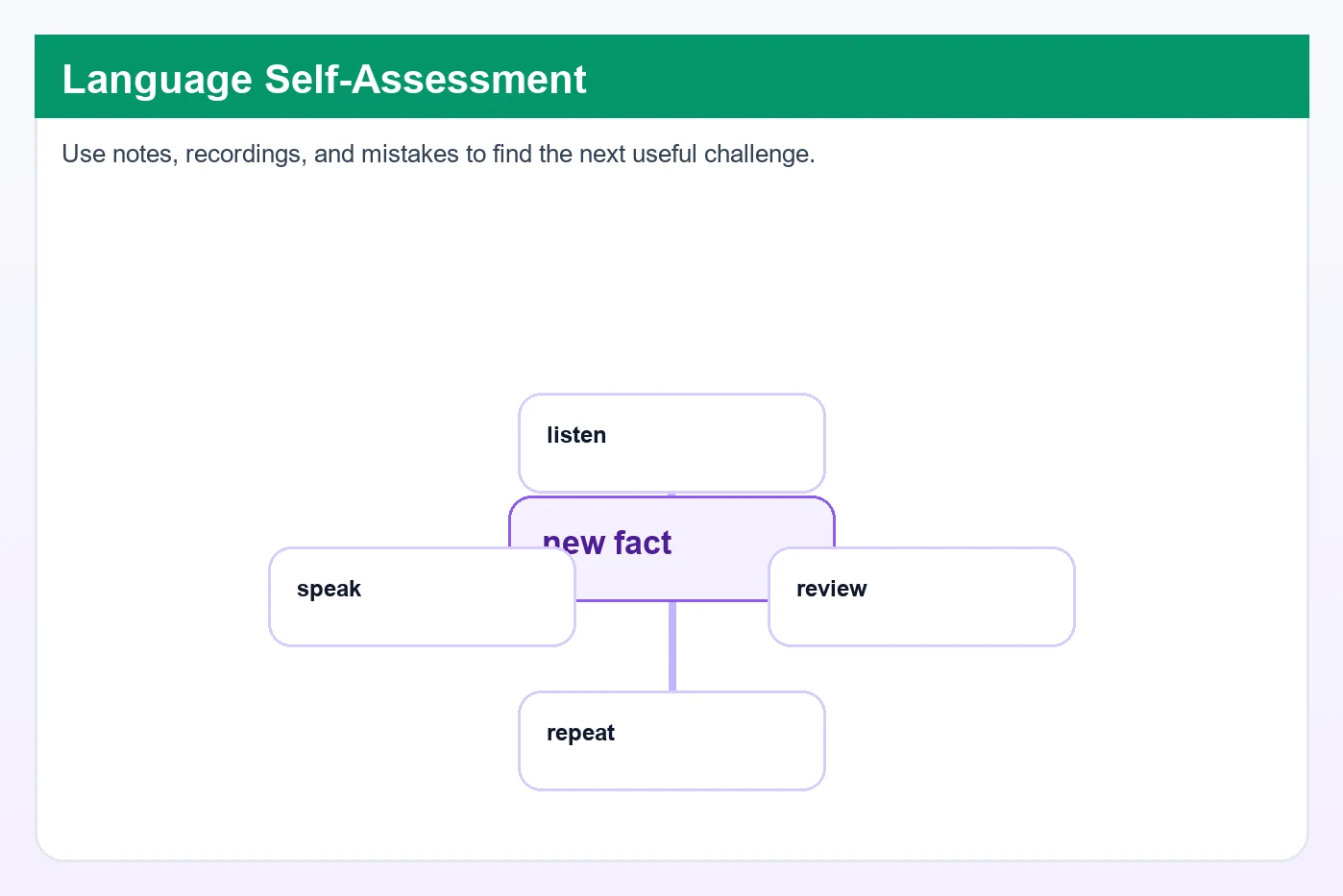
Personally, I think this is the part most learners skip. They ask how to get out of plateau in language learning, but they never identify whether the real issue is speaking, listening, recall, correction, or recovery. And yes, those need different fixes.
The 5-minute self-assessment: identify your plateau type
If you’re wondering how can I tell if I am stuck in language learning, use a scorecard. Rate yourself from 1 to 5 in four areas: speaking, listening, vocabulary recall, and grammar/pronunciation. Then pick the single lowest score as your main bottleneck for the next 2 weeks.
- Speaking: record a 60-second monologue on your day without pausing to translate.
- Listening: hear a 2-minute clip at your level, then summarize it out loud.
- Vocabulary recall: try to produce 20 recent words from memory and use 10 in sentences.
- Grammar/pronunciation: write 6-8 sentences, then read them aloud and mark repeated errors.
Why only one bottleneck? Because trying to fix four weaknesses at once usually creates noise, not progress. If your speaking plateau in language learning is a 2, but listening is a 4, your next move is obvious: more output, less random browsing.
A good self-assessment also tests explanation. Try teaching a grammar point or retelling a short article in simple words; that’s one reason I like using the idea behind Feynman technique effectiveness for language practice. If you can recognize a rule but can’t explain or apply it, you probably don’t own it yet.
Cause vs fix: what your symptoms usually mean
Here’s the practical framework most people need when asking why am I not improving in language learning. Match the symptom to the likely cause, then test the fix for one week before changing course.
📋 Quick Reference
Understand but freeze when speaking → output bottleneck → do daily speaking with correction.
Learn words then forget them → weak retrieval → use spaced repetition plus sentence recall and deeper encoding with elaborative rehearsal examples.
Native audio feels too fast → listening level mismatch → use narrow listening with transcripts, then re-listen without text.
Keep making the same grammar mistakes → weak feedback loop → get corrections on a small set of repeated patterns.
Everything feels harder lately → burnout, poor sleep, or unrealistic goals → reduce load and restore recovery first.
Recognition without recall is a classic vocabulary plateau in language learning. Research on retrieval practice, summarized in a review on test-enhanced learning in PubMed Central, suggests memory gets stronger when you actively pull information out, not just re-read it.
And what about the listening plateau in language learning? Usually, native audio isn’t “too fast” in a global sense. It’s just too dense for your current parsing speed. Use one speaker, one topic, one transcript, and repeated passes. But wait — the same symptom can come from weak vocabulary, so test rather than guess.
Mistakes that keep learners stuck longer
The biggest mistake is confusing exposure with practice. Hours of scrolling subtitles, switching apps, or saving word lists can feel productive while producing almost no measurable output. That’s why how to get out of plateau in language learning depends on outcomes, not effort vibes.
Use goals like these instead of “study for an hour”:
- 10 corrected sentences
- 3 shadowed audio clips
- 15 recalled words used in context
Another trap is perfectionism. You delay speaking until you feel ready, which means you never get the messy repetitions that build fluency. If that sounds familiar, read this on how to stop perfectionism procrastination. Also, language immersion vs study plateau isn’t an either-or debate; immersion helps, but immersion alone won’t save you if attention, feedback, and active retrieval are missing.
And sometimes the real answer to how to get out of plateau in language learning is recovery, not intensity. Sleep loss, stress, and cognitive overload hurt attention and memory consolidation; the American Psychological Association’s stress resources explain why chronic stress can impair learning. If stress, anxiety, sleep problems, or burnout are significantly affecting your learning, consult a qualified healthcare professional.
So here’s the deal: identify one bottleneck, match it to one cause, and use one fix long enough to measure change. That’s how to get out of plateau in language learning without wasting another month guessing — and it sets up the 7-step reset plan in the next section.
How to break a language learning plateau in 7 steps
Now that you know why you’re stuck, here’s the practical fix. If you’re wondering how to get out of plateau in language learning, the answer usually isn’t “study more” — it’s “study narrower, with better feedback.”
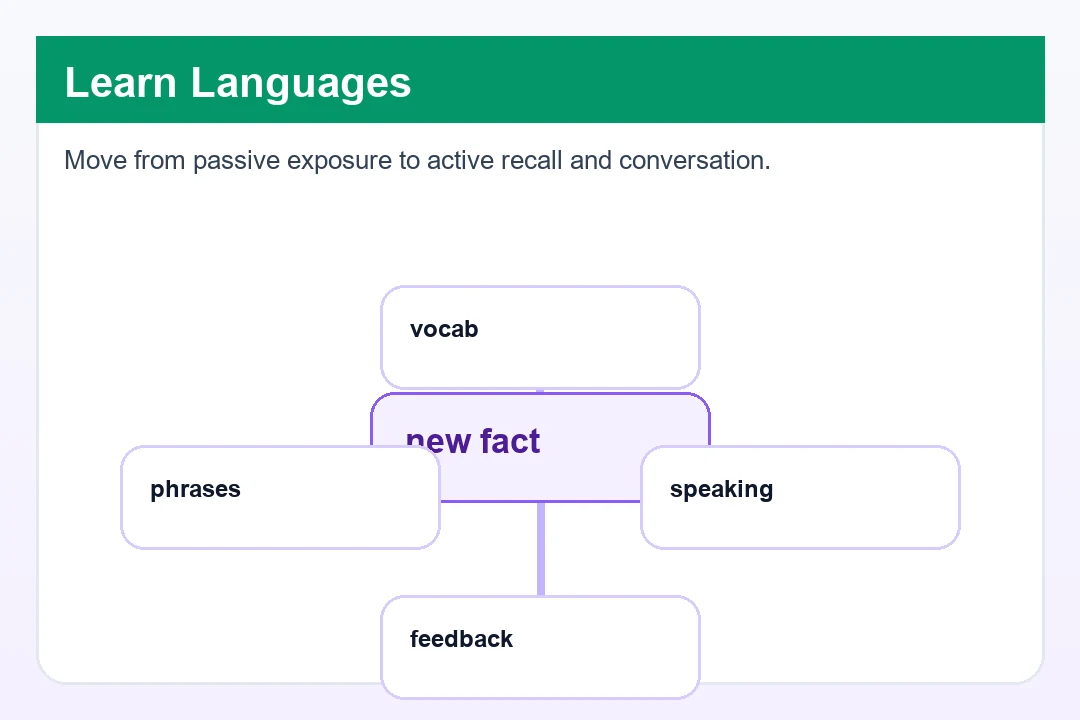
And yes, input still matters. But passive exposure alone won’t do much unless it’s paired with targeted practice, which is why a balanced immersion language learning guide matters more than random binge-listening.
The 7-step breakthrough system
How to get out of plateau in language learning
- Step 1: Pick one bottleneck for 14 days. Not “get better at Spanish.” Too vague. Try “understand 70% of a 3-minute podcast with transcript support” or “speak for 2 minutes with fewer than 5 long pauses.” If your plateau is everywhere, your target is nowhere.
- Step 2: Raise difficulty by about 10-15%, not 50%. This is the part most people get wrong. If you understand 60% of a clip, move to one that feels slightly harder, not impossible. The best way to overcome language plateau is tension without panic.
- Step 3: Add daily output with correction. Five spoken sentences. One 60-second voice note. One corrected paragraph. One short tutor exchange. Speaking plateau? Record and compare. Grammar plateau? Write and get edits. Vocabulary plateau? Use new words in context, not just flashcards.
- Step 4: Use active recall and spaced repetition. Research on retrieval practice, including work summarized by cognitive scientists like Henry Roediger, suggests recall beats rereading for long-term retention. So don’t just recognize words — retrieve full sentences, collocations, and responses after 1 day, 3 days, and 7 days. For deeper encoding, these elaborative rehearsal examples help turn “I’ve seen it” into “I can use it.”
- Step 5: Tighten the feedback loop. Use tutor corrections, exchange partners, transcripts, and your own recordings. And if you need targeted prompts for role-plays or error drills, learn to use AI properly for students so you generate practice ethically instead of outsourcing thinking.
- Step 6: Track one weekly number. Examples: words recalled after 48 hours, listening comprehension percentage, speaking duration, grammar error rate, or number of successful paraphrases. Want to know how to break language plateau fast? Measure something boring but real.
- Step 7: Protect consistency and recovery. Build fallback sessions of 2-10 minutes for bad days. Sleep matters too — memory consolidation depends on it, and evidence from sleep research consistently shows that poor sleep weakens learning retention. Marathon sessions feel productive. Daily reps work better.
Real-world application: what this looks like in a busy week
OK wait, let me back up. How to break a language learning plateau has to fit real life, or it won’t last past Tuesday.
- Weekdays: 15 minutes vocabulary retrieval, 10 minutes narrow listening, 5 minutes speaking output
- Weekend: one 30-minute correction session with a tutor, exchange partner, or self-review using recordings and transcripts
A busy professional could do retrieval during a commute, listening at lunch, and a voice note in the evening. That’s 30 minutes total. Not flashy, but it creates repetition, output practice, and deliberate practice in the same week.
Personally, I think this is the best way to overcome language plateau for most intermediate learners because it removes the all-or-nothing trap. Miss one day? Fine. Don’t miss four.
Tools and supports that make the steps easier
Speaking of which — tools help when they shorten the loop between attempt and correction. Record yourself, compare with a transcript, then explain the grammar point out loud in simple terms. That kind of explanation-based practice is often where vocabulary and grammar finally transfer into real use.
Three supports matter: transcripts for listening accuracy, recordings for speaking feedback, and spaced repetition for retrieval strength. If you’re still wondering how to get out of plateau in language learning, that trio is usually the missing system.
Next, we’ll break this down by plateau type — speaking, listening, vocabulary, and grammar — and turn it into a practical 30-day recovery plan.
Fixes by plateau type: speaking, listening, vocabulary, grammar — plus a 30-day recovery plan
If the 7-step reset showed you what’s wrong, this section shows you exactly what to do next. And if you’re still wondering how to get out of plateau in language learning, the answer is usually not “study more” but “match practice to the bottleneck.”
Fixes by plateau type
Here’s the fast diagnosis. A speaking plateau in language learning needs output and correction. A listening plateau in language learning needs controlled input. A vocabulary plateau in language learning needs retrieval, not more highlighting. Grammar and pronunciation stalls need pattern-focused drills, one error at a time. That’s the real answer to how to get out of plateau in language learning.
- Speaking: Best exercise: 60-90 second monologues on familiar topics, then repeat after corrections. Metric: one 2-minute speaking sample each week. Trap: passive study that feels safe but never forces recall. If you freeze in live conversation, performance anxiety may be part of the problem, so try a quick reset with reduce anxiety immediately before speaking practice.
- Listening: Best exercise: narrow listening with one speaker or topic, then compare your understanding against a transcript. Metric: estimated comprehension percentage; aim to move from 50% to 70% before increasing difficulty. Trap: jumping straight into fast native audio and calling yourself “bad at listening.”
- Vocabulary: Best exercise: sentence cards plus delayed recall. Metric: 15/20 words recalled after 24 hours, not just recognized. Trap: rereading word lists. If you’re asking how to fix vocabulary plateau in language learning, this is the part most people get wrong: recognition isn’t usable knowledge.
- Grammar/pronunciation: Best exercise: pick one recurring error pattern, drill it, and record before/after samples weekly. Metric: reduce 3 repeated errors to 1. Trap: trying to “fix grammar” as one giant category.
Want specifics? For how to fix speaking plateau in language learning, use monologues, conversation scripts, shadowing, and correction-based repetition. For how to fix listening plateau in language learning, use short clips, replay them 3-5 times, slow them slightly, then return to natural speed. For how to fix vocabulary plateau in language learning, move from flashcard recognition to category recall, elaboration, and active sentence production.
The 30-day plateau recovery plan
If you want to know how to overcome intermediate language plateau without burning out, use a 30 day plan to break language plateau into weekly themes. Personally, I think this works better than chasing motivation.
- Week 1: Diagnose and baseline. Keep one main resource, remove extras, and test your current level with a 2-minute speaking sample, one short audio clip, and a 20-word recall check.
- Week 2: Focused practice. Spend 15-25 minutes daily on one bottleneck only. This is your best exercises for language learning plateau phase.
- Week 3: Feedback and adjustment. Add corrections, compare recordings, and raise difficulty slightly if success is above 80%.
- Week 4: Consolidate. Retest, keep what worked, and set the next 14-day milestone. Sleep matters here too, because retention depends heavily on sleep memory consolidation.
That’s also how to get out of plateau in language learning when the real issue is inconsistency. One bottleneck, one metric, one month. Simple beats scattered.
Quick reference: what to do today in under 15 minutes
📋 Quick Reference
Pick one bottleneck. Do one 5-minute test. Do one 5-minute practice block. Write down one metric to track for 7 days.
Examples: record a 60-second monologue, replay a 30-second audio clip until you hit 70% comprehension, or recall 10 target words from memory. The best way to overcome language plateau is targeted practice plus feedback, not just more time.
So here’s the deal: if you’ve been stuck, the fix is usually narrower than you think. And that’s the practical core of how to get out of plateau in language learning. Next, let’s answer the common questions people still have before they commit to the plan.
Frequently Asked Questions
What is a language learning plateau?
A language learning plateau is a period where your visible progress slows down, usually because your current study routine no longer matches the next skill you need to build. In practice, that often means you’re doing more of what feels comfortable instead of training the weak link that would move you forward. If you’re wondering what is a language learning plateau, that’s the core idea — and it’s a big part of how to get out of plateau in language learning. Plateaus are especially common when you move from beginner to intermediate, and again at the intermediate stage when improvement becomes less obvious day to day.
How do I get out of a plateau in language learning?
If you want to know how to get out of plateau in language learning, start by identifying one bottleneck: listening speed, speaking accuracy, vocabulary recall, reading fluency, or grammar under pressure. Then add retrieval practice, more output, real correction, and a simple weekly scorecard such as “minutes spoken,” “clips understood,” or “errors fixed.” But wait — this is the part most people get wrong: don’t change five variables at once, because then you won’t know what actually worked. Pick one problem, run one focused experiment for 2 weeks, and review measurable results before adjusting again.
Why am I not improving in language learning even though I study a lot?
The short answer? Exposure isn’t the same as deliberate practice. If you’re asking why am i not improving in language learning, you may be spending lots of time around the language without forcing recall, producing answers, or getting feedback on mistakes — which also explains how to get out of plateau in language learning. Common causes include passive input, weak correction, poor sleep, and material that’s either too easy or unrealistically hard; research on sleep and memory consolidation from the National Institute of Neurological Disorders and Stroke is a useful reminder that recovery matters too. A better test is simple: after each session, can you do something new, faster, or more accurately than last week?
How long does a language plateau last?
How long does a language plateau last? It depends on the language you’re learning, how much time you can realistically give it, and — honestly — the quality of your practice. For most learners, the better question isn’t “how long will this feeling last?” but “am I seeing any measurable change in 2 to 4 weeks?” That’s a practical way to think about how to get out of plateau in language learning: if nothing improves after 2-4 weeks of focused work on one skill, your method probably needs adjustment rather than more patience.
How do you fix a speaking plateau in language learning?
If you’re stuck on how to fix speaking plateau in language learning, use short daily speaking reps instead of waiting for long perfect conversations. A strong routine looks like this: record 2-5 minutes, get correction, repeat the same structures in new contexts, and compare this week’s recording to last week’s — that’s one of the clearest ways to practice how to get out of plateau in language learning. And yes, anxiety can make speaking plateaus worse, so if stress keeps blocking output, build in grounding habits and check FreeBrain’s stress resources or supportive routines; if anxiety feels persistent or overwhelming, it’s worth talking with a qualified professional.
How do you fix a listening plateau in language learning?
The best answer to how to fix listening plateau in language learning is usually narrow listening: stay with one speaker, topic, or format long enough for your brain to adapt. Use transcripts, replay short clips, and work with level-matched audio before jumping into full native-speed content, because that’s often the missing step in how to get out of plateau in language learning. Personally, I think vague impressions are useless here, so track comprehension percentage instead — for example, “I understood 65% of a 90-second clip on first listen, then 85% after transcript review.” If you want a research-based overview of why active recall and retrieval matter during learning, this widely cited review on retrieval practice is a good place to start.
Conclusion
If you want a practical answer for how to get out of plateau in language learning, keep it simple: diagnose the exact bottleneck, raise the difficulty just a little, switch from passive review to active recall, and follow one focused 30-day plan instead of chasing random resources. That means testing whether your real problem is speaking, listening, vocabulary, or grammar, then matching your practice to that weak point. And yes, this is the part most people get wrong. They study more, but not smarter. A plateau usually breaks when your practice gets more specific, more measurable, and slightly uncomfortable.
But wait. Being stuck doesn’t mean you’ve stopped learning. It usually means your brain has adapted to your current routine, so your next gains need a different kind of effort. Personally, I think that’s frustrating—but also encouraging. Why? Because it means you’re not broken, and your language learning plateau isn’t permanent. If you’ve been wondering how to get out of plateau in language learning, start smaller than you think: one daily speaking drill, one listening loop, one retrieval session, one weekly review. Done consistently, those small upgrades add up fast.
Which brings us to your next move: don’t just finish this article and hope motivation carries you. Build a system. On FreeBrain.net, you can keep improving with practical guides like How to Study Effectively and Spaced Repetition. If you come back to the question of how to get out of plateau in language learning, return to your weak point, adjust the drill, and keep the reps going. Pick your first exercise today, schedule the next 7 days, and start moving again.