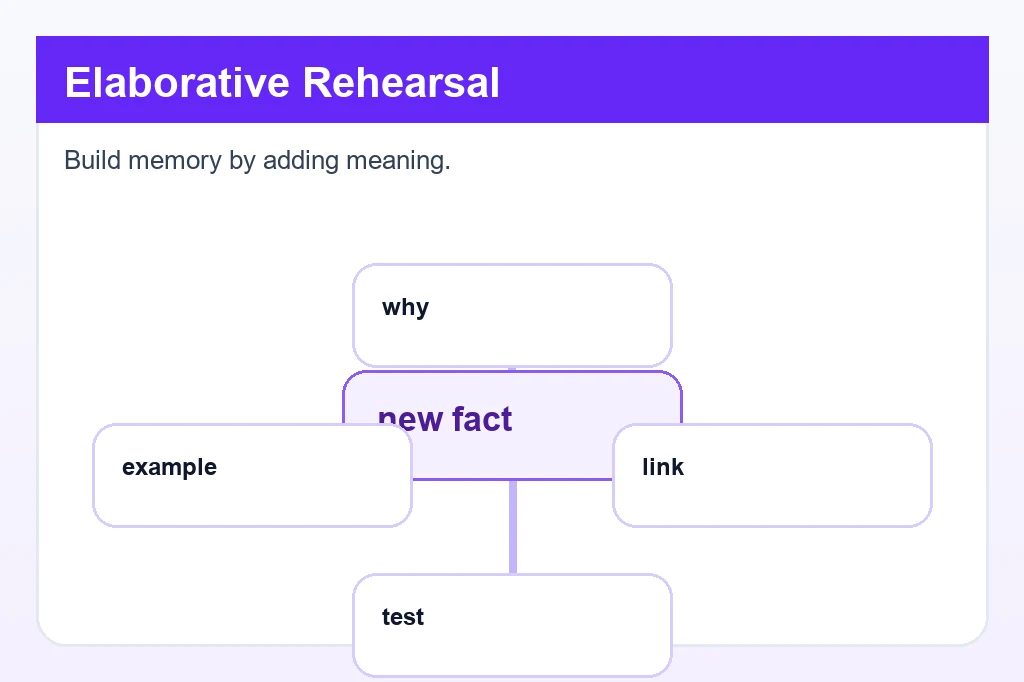
If you want a fast answer, an example of elaborative rehearsal is taking a fact and connecting it to meaning, prior knowledge, or a real example so your brain has more than one way to find it later. Instead of repeating “mitochondria is the powerhouse of the cell” ten times, you might compare it to a phone battery that powers every app you use. That kind of example of elaborative rehearsal sticks better because you’re not just saying the idea — you’re explaining it.
You’ve probably felt the opposite. You reread a page, highlight half of it, and think you know it — then the answer disappears during the quiz. Research on levels of processing, summarized in the levels of processing framework in psychology, points to a simple reason: deeper, meaning-based processing tends to produce stronger memory than shallow repetition. So what does a real example of elaborative rehearsal look like when you’re studying biology, math, history, or vocabulary under time pressure?
That’s what this article will show you. You’ll get a clear definition, seven practical examples, and a side-by-side look at elaborative rehearsal vs maintenance rehearsal so you know when repeating is useful and when it’s wasting your time. We’ll also cover how to use elaborative rehearsal for studying before, during, and after a session — including how it pairs with active recall, spaced repetition, and explaining ideas in your own words, which is why articles like is the Feynman technique effective connect so closely to this method.
Personally, I think this is the part most students miss. As a software engineer and self-taught learner building FreeBrain tools, I’ve spent a lot of time testing which study remembering techniques actually hold up outside the lab, especially when you need a workflow that starts with reading efficiently, like how to read faster without losing comprehension, and ends with remembering more a week later. By the end, you won’t just know what is an example of elaborative rehearsal study in theory — you’ll know how to build your own example of elaborative rehearsal on demand.
📑 Table of Contents
- What Is an Example of Elaborative Rehearsal? Fast Definition, Why It Works, and a Quick Reference
- 7 Elaborative Rehearsal Study Techniques That Actually Work
- How to Use Elaborative Rehearsal for Studying: Step-by-Step Workflow and Real-World Application
- Elaborative Rehearsal vs Maintenance Rehearsal: Common Mistakes, What to Avoid, and Exam Prep FAQ
- Frequently Asked Questions
- Conclusion
What Is an Example of Elaborative Rehearsal? Fast Definition, Why It Works, and a Quick Reference
Now that you’ve got the big picture, here’s the plain-English version. An example of elaborative rehearsal is when you don’t just repeat a fact—you connect it to meaning, prior knowledge, causes, or your own explanation so it sticks in long-term memory better than rote repetition. For more on learning and study skills, see our learning and study skills guide.
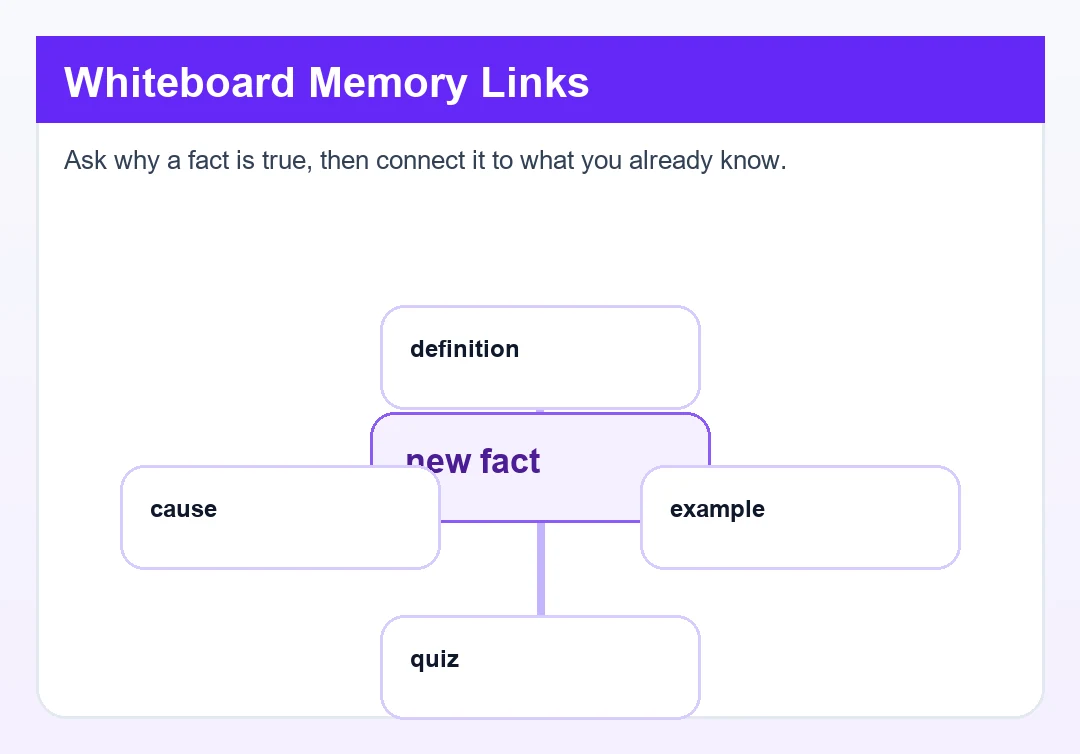
So what does that look like in real study? Instead of saying “mitochondria is the powerhouse of the cell” ten times, you explain that mitochondria work like a phone battery powering tasks, then connect that idea to ATP production in biology. That’s why questions like what is an example of elaborative rehearsal study matter: the method is about understanding, not chanting. If you’re wondering whether explaining ideas in your own words helps, see is the Feynman technique effective.
In cognitive psychology, this idea fits the levels-of-processing framework from Craik and Lockhart, which argues that deeper semantic processing usually leads to stronger memory than shallow repetition. You can read a quick overview of the levels-of-processing effect and broader background on elaborative rehearsal in psychology. Personally, I think the practical test is simpler: as a software engineer and self-taught learner building FreeBrain study resources, I ask one question—can you still explain it tomorrow and next week?
One quick trust note. Research suggests elaborative rehearsal memory depends partly on sleep, stress, attention, and task type, so this article is educational, not medical advice. If you have major memory or attention concerns, consult a qualified professional.
Definition: What is elaborative rehearsal in psychology?
What is elaborative rehearsal in psychology? It’s a memory strategy where you encode new information by adding meaning—through examples, comparisons, causes, or personal explanations—instead of just repeating words. That deeper semantic encoding gives the material a better shot at reaching long term memory.
A simple example of elaborative rehearsal in school
Here’s a clean example of elaborative rehearsal from school. Weak version: repeat “mitochondria produce energy” ten times and hope it stays there. Stronger version: explain how mitochondria convert nutrients into ATP, compare them to a battery, and generate your own example of why active cells need more energy.
That’s the whole shift. You move from surface repetition to deep processing. And yes, this also works when you turn textbook notes into questions and connections using how to take notes from a textbook fast, or when you pair meaning with vivid associations from memory palace technique examples.
- Repeat = maintenance rehearsal.
- Explain = elaboration.
- Compare = stronger retrieval cues.
- Generate your own example = better transfer on tests.
Quick Reference: maintenance vs elaborative rehearsal
📋 Quick Reference
- Maintenance rehearsal: repeat the exact words to keep them active briefly.
- Elaborative rehearsal: connect the idea to meaning, causes, examples, or prior knowledge.
- Best use: maintenance helps short-term holding; elaborative rehearsal helps long-term retention.
- Fast test: if you can teach it in your own words, that’s usually an example of elaborative rehearsal.
That distinction matters because the next step isn’t just knowing one example of elaborative rehearsal—it’s learning how to use the method across subjects, on purpose, every time you study. Which brings us to seven techniques that actually work.
7 Elaborative Rehearsal Study Techniques That Actually Work
Now that you’ve seen a fast definition, let’s make it usable. The best example of elaborative rehearsal isn’t one trick—it’s a set of moves that help you connect, explain, and retrieve ideas instead of just rereading them.
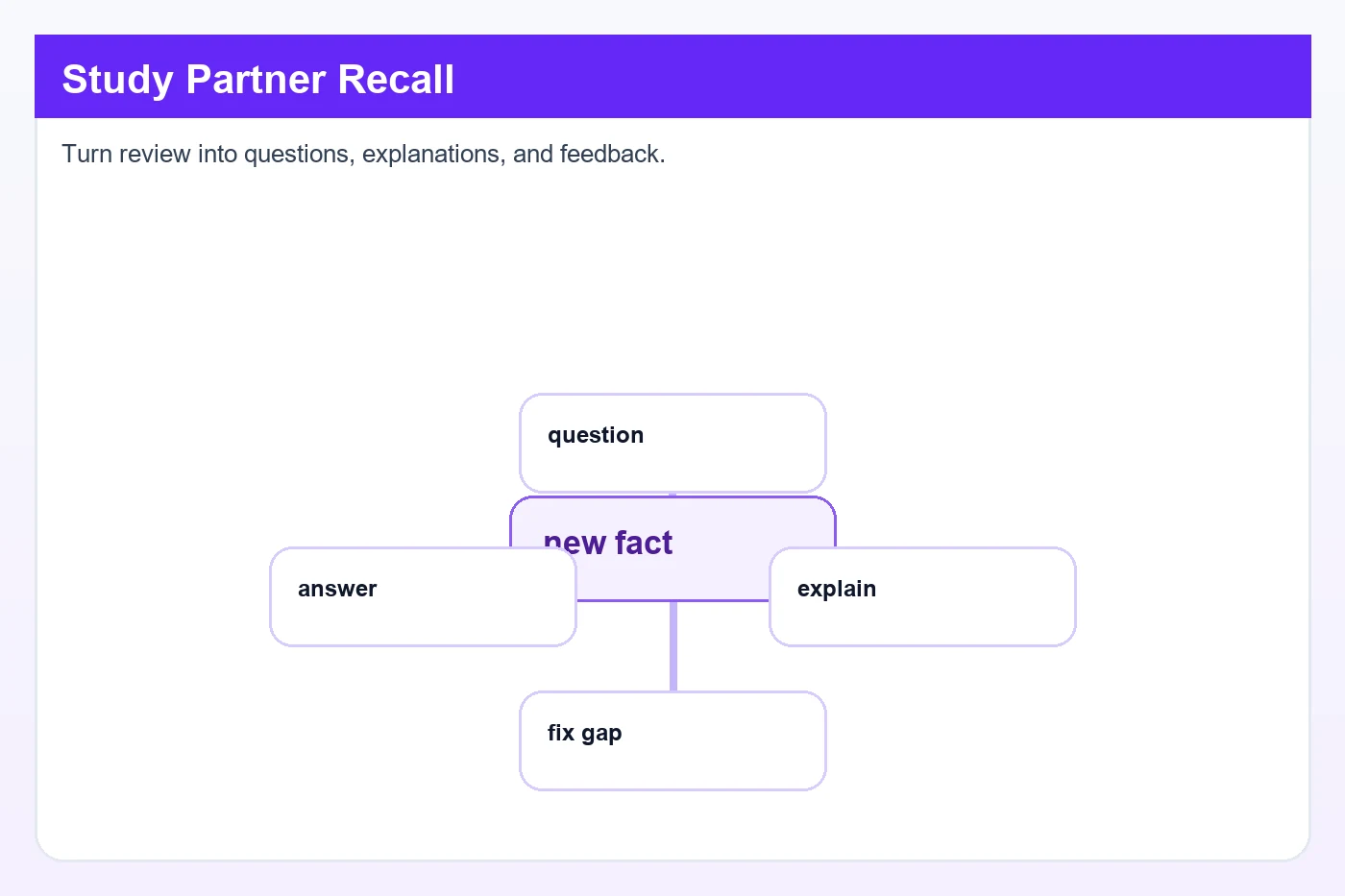
Ask, connect, and explain
Three elaborative rehearsal study techniques do most of the heavy lifting: asking why, linking to what you already know, and explaining ideas in your own words. Cognitive psychology has long shown that meaningful processing improves memory more than shallow repetition, which fits the classic levels of processing framework. And if you’ve ever wondered is the Feynman technique effective, yes—because self-explanation is basically an example of elaborative rehearsal with extra precision.
- Ask why and how questions. Don’t stop at definitions. In economics, an example of elaborative rehearsal is asking why inflation reduces purchasing power and how that changes what the same $100 can buy next year.
- Link new ideas to prior knowledge. New material sticks when it attaches to something already in memory. For science, compare electrical current to water flow in a pipe—but note where the analogy breaks, because voltage and pressure aren’t perfectly identical.
- Use self-explanation while solving. After each math step, explain why it’s valid: “I divided both sides by 3 to isolate x.” That creates retrieval cues you can reuse on the next problem.
Personally, I think this is the part most students skip. They collect notes, but they don’t transform them. If you’re learning from dense chapters, turning headings into questions is also one of the fastest ways to apply an example of elaborative rehearsal while using how to take notes from a textbook fast.
Build examples, contrasts, and stories
Good elaboration is specific, not vague. A strong elaborative rehearsal study techniques example uses details from the actual topic you’re learning, whether that’s psychology in school or a technical workflow at work.
- Make your own examples. In psychology, don’t reuse Pavlov’s dog again. Create a pet-training scene where a clicker predicts a treat; that fresh example of elaborative rehearsal forces you to understand classical conditioning, not copy it.
- Compare and contrast similar concepts. Put mitosis vs. meiosis, classical vs. operant conditioning, or velocity vs. acceleration side by side. Ask: what stays the same, what changes, and why does the distinction matter on a test?
- Turn facts into stories or associations. For cranial nerves or a history timeline, build a mini narrative with sequence and cause. The story method memory technique works even better when paired with spatial cues like these memory palace technique examples.
Use diagrams and dual coding without making it passive
The last technique is pairing words with visuals. For biology, sketch a nephron, label the parts, and explain filtration and reabsorption in plain language; that’s a concrete example of elaborative rehearsal because the drawing supports thinking instead of replacing it.
But wait. Don’t spend 20 minutes decorating notes with color gradients and call it studying. One of the best memory strategies for studying is dual coding with recall: draw from memory, label from memory, then check what you missed.
So your seven techniques are clear: ask why/how, connect to prior knowledge, make your own examples, self-explain, compare and contrast, build stories, and pair words with diagrams. Next, I’ll show you exactly how to use elaborative rehearsal for studying before, during, and after a real study session.
How to Use Elaborative Rehearsal for Studying: Step-by-Step Workflow and Real-World Application
You’ve seen the techniques. Now let’s turn them into a study workflow you can actually use tonight. The fastest way to get an example of elaborative rehearsal working for real classes is to build it into what you do before, during, and after each session.
How to use elaborative rehearsal for studying
- Step 1: Preview the material, set one clear goal, and write 3-5 anchor questions.
- Step 2: Study in 25-40 minute focused blocks, not marathon sessions.
- Step 3: After each chunk, answer: What does this mean? What does it connect to? What example can I create?
- Step 4: Close the page and do a short active recall check without looking.
- Step 5: Turn your notes into 5-10 retrieval questions and review them later the same day, then after 2, 7, and 30 days.
Before the session: prepare for deep processing
Start with a target. Not “study chapter 4,” but “explain operant conditioning and compare it to classical conditioning.” That small shift changes your whole study workflow because you’re aiming to understand, not just get through pages.
Next, preview headings, diagrams, bold terms, and summaries. If the reading load is heavy, use efficient reading habits from how to read faster without losing comprehension so you save energy for the thinking part. Then write 3-5 anchor questions before reading, like: “Why does this process happen?” or “How would I teach this to a beginner?”
And don’t begin with passive highlighting. Personally, I think this is the part most people get wrong. A simple example of elaborative rehearsal here would be turning “mitosis has stages” into “Why does the cell need stages instead of dividing all at once?”
During the session: elaborate, then retrieve
After each small section, pause and answer three prompts:
- What does this mean?
- What does it connect to?
- What example can I create?
That’s the core loop. Read a bit, explain it in your own words, then test yourself. If you’ve ever wondered is the Feynman technique effective, this is why it helps: explanation forces deeper encoding.
Here’s an example of elaborative rehearsal from psychology: instead of memorizing “working memory is limited,” connect it to trying to remember a phone number while solving a math problem. In biology, don’t just note “enzymes lower activation energy.” Ask how that compares to using a ramp to move a heavy box instead of lifting it straight up.
Then do immediate retrieval practice. Close the book and recall the idea without looking for 30-60 seconds. Research in cognitive psychology, including work summarized by Roediger and Karpicke’s testing effect literature, suggests retrieval practice improves long-term retention better than rereading alone.
After the session: review on a 2-7-30 pattern
Now convert notes into 5-10 questions, prompts, or flashcards. If your notes are messy, this guide on how to take notes from a textbook fast helps you capture fewer words and more usable cues. A good example of elaborative rehearsal becomes a good retrieval question, like: “What real-life situation shows negative reinforcement?”
Review the set later the same day, then again after 2, 7, and 30 days. Is that the magic answer to “what is the 2 7 30 rule for memory”? Not exactly. It’s just a practical spaced repetition rhythm that’s easy to follow, and easy beats perfect.
From Experience: what held up outside the lab
While building FreeBrain resources, I noticed the most durable learning came from combining elaboration with active recall, not from making longer notes. Well, actually, longer notes often made recall worse because students felt productive without testing anything.
The best memory strategies for studying usually look boring: short focused blocks, one solid example of elaborative rehearsal per concept, and repeated retrieval over time. Another example of elaborative rehearsal is linking a new economics term to a purchase you made this week, then recalling that link tomorrow without notes. That’s how to combine elaborative rehearsal with active recall in a way that survives real exams.
Next, we need to clean up the confusion: elaborative rehearsal can work extremely well, but maintenance rehearsal still sneaks in. Which brings us to the mistakes, what to avoid, and the exam-prep questions students ask most.
Elaborative Rehearsal vs Maintenance Rehearsal: Common Mistakes, What to Avoid, and Exam Prep FAQ
Now that you’ve seen the workflow, the next question is simple: when should you use elaboration, and when is plain repetition enough? The difference matters because one good example of elaborative rehearsal can build durable recall, while mindless repetition often fades fast.
Comparison table: elaborative rehearsal vs maintenance rehearsal
| Type | Goal | Method | Example | Best use case | Likely retention |
|---|---|---|---|---|---|
| Maintenance rehearsal | Keep info active briefly | Repeat it again and again | Repeating a new phone number or saying “mitosis, mitosis, mitosis” before writing it down | Short-term holding, immediate recall, early familiarization | Usually weak later recall |
| Elaborative rehearsal | Store info with meaning | Connect, explain, compare, and generate examples | Vocabulary: connect “photosynthesis” to “plants making sugar from light.” Science: compare diffusion to perfume spreading in a room | Concept learning, exam prep, long-term retention | Much stronger later recall |
So what is the difference between maintenance and elaborative rehearsal? Maintenance rehearsal keeps information alive for the next few seconds or minutes. An example of elaborative rehearsal, by contrast, adds meaning so your brain has more paths back to the idea later.
And yes, maintenance rehearsal still has a job. It’s useful for a locker code, a quick formula before you copy it, or the first pass through unfamiliar material before you understand it well enough to elaborate.
Common mistakes that make elaboration too shallow
This is the part most people get wrong. They think elaboration means “more notes,” when it really means “more meaning.”
- Copying the teacher’s example instead of generating your own
- Highlighting a paragraph without explaining it in plain language
- Adding detail but never testing retrieval
- Spending 45 minutes making pretty notes instead of practicing recall
- Confusing familiarity with memory because the page looks recognizable
Well, actually, a weak example of elaborative rehearsal is still better than none, but shallow elaboration has limits. If you underline “classical conditioning” and write “dog bell experiment,” you may feel fluent without being able to explain stimulus, response, and prediction on test day.
A better example of elaborative rehearsal is making your own connection: “Classical conditioning is learning by association; my phone notification sound makes me reach for my pocket before I even think.” That’s personal, concrete, and easier to retrieve. If you like learning by explanation, you might also like is the Feynman technique effective, because teaching ideas in simple words is a strong form of elaboration.
When this helps most for exams
Can elaborative rehearsal help with exam prep? Yes, especially for high-yield concepts that require transfer, not just recognition. Research in cognitive psychology, including work summarized by Henry Roediger and Jeffrey Karpicke on retrieval practice, suggests that recall practice beats rereading for long-term retention.
But wait. Under time pressure, don’t elaborate every tiny fact. Use one strong example of elaborative rehearsal for the concepts most likely to appear in application questions, then switch fast to retrieval and spaced review. That’s why this works better than cramming.
Three things matter: meaning, access, and timing. Build meaning with an example of elaborative rehearsal, build access with active recall, and build durability with spaced repetition. If you’re studying on a deadline, our guide on how to study for the SAT in a month shows how to prioritize high-yield topics without drowning in notes.
Educational note: memory, attention, stress, and sleep all affect study performance. If you’re dealing with persistent memory problems, ADHD symptoms, anxiety, or major sleep issues, talk with a qualified healthcare professional rather than trying to self-diagnose from study advice online.
The best system is simple: elaboration for meaning, retrieval for access, and spacing for durability. In the next section, I’ll wrap this up with quick answers to the most common questions and the best next step to try on FreeBrain.
Frequently Asked Questions
What is an example of elaborative rehearsal study?
A clear answer to what is an example of elaborative rehearsal in studying is this: when you learn osmosis, you compare it to how a dry sponge pulls in water or how water moves into plant roots after rain. That kind of meaningful association works because you’re attaching the new idea to something you already understand, which makes recall easier later. By contrast, rote repetition would just be saying “osmosis is the movement of water across a membrane” again and again without adding meaning.
What is elaborative rehearsal in psychology?
If you’re asking what is elaborative rehearsal in psychology, it means rehearsing information by adding meaning, links, examples, and prior knowledge rather than only repeating it. In simple terms, it fits with the levels of processing idea: the deeper you think about what something means, the more likely you are to remember it. An example of elaborative rehearsal would be connecting a psychology term like classical conditioning to a real-life habit, not just memorizing the definition.
How to use elaborative rehearsal for studying?
The simplest answer to how to use elaborative rehearsal for studying is a 3-part routine: connect, explain, then test yourself. Before studying, preview the topic and ask what it reminds you of; during studying, explain each concept in your own words and build an example of elaborative rehearsal for each major idea; after studying, close your notes and retrieve the idea from memory. If you want a practical system, pair this with spaced review using FreeBrain’s study tools and planners so you revisit the same concepts at the right times.
What is the difference between maintenance and elaborative rehearsal?
For anyone wondering what is the difference between maintenance and elaborative rehearsal, the short version is this: maintenance rehearsal repeats, while elaborative rehearsal adds meaning and connections. Saying a phone number over and over is maintenance rehearsal; linking a biology concept to a real-world process is an example of elaborative rehearsal. Both can help, but they serve different goals—maintenance is better for short-term holding, while elaborative rehearsal is usually better for long-term learning.
What is the 2 7 30 rule for memory?
If you want to know what is the 2 7 30 rule for memory, it’s a practical review rhythm where you revisit material after 2 days, 7 days, and 30 days. It’s not a universal law or a magic formula, just a useful study heuristic that lines up with what memory research suggests about spaced repetition; you can read more about the science of spacing at NCBI. To make it work better, don’t just reread—use an example of elaborative rehearsal during each review by explaining the idea, comparing it to something familiar, or answering a question from memory.
Can elaborative rehearsal help with exam prep?
Yes—if you’re asking can elaborative rehearsal help with exam prep, it tends to work especially well in concept-heavy subjects like biology, psychology, history, and medicine, where understanding matters more than surface memorization. An example of elaborative rehearsal during exam prep would be explaining a theory in plain language, linking it to a case, and then retrieving it without notes. It works best when you combine it with retrieval practice and spaced repetition, which is why I usually recommend pairing it with a structured review schedule and self-testing rather than passive rereading; APA’s overview of learning and memory is a good starting point if you want the research angle.
Conclusion
If you want elaborative rehearsal to actually stick, keep four moves in mind: connect new facts to what you already know, turn abstract ideas into concrete examples, ask “why” and “how” questions, and practice retrieval instead of just rereading. That’s the real pattern behind every strong example of elaborative rehearsal in this article. Whether you’re comparing concepts, making analogies, teaching the idea out loud, or linking terms to personal experience, the goal is the same: give your brain more meaning to work with. And yes, that usually beats simple repetition.
Thing is, you don’t need perfect notes or a fancy system to start. You just need one small upgrade to how you study today. Pick one example of elaborative rehearsal before your next session and use it on a single topic for 10 minutes. That’s enough to feel the difference. If you’ve been frustrated by forgetting material right after reviewing it, you’re not bad at learning — you probably just needed a method that helps your brain build stronger connections.
Want to keep going? Explore more practical study strategies on FreeBrain.net, including Active Recall: The Study Method That Actually Builds Memory and Spaced Repetition: How to Remember What You Study. Used together with a solid example of elaborative rehearsal, those methods can make your study sessions far more effective. Start with one chapter, one concept, and one better question — then build from there.