

If you’re wondering whether the best brain games for adults actually make your brain better, here’s the short answer: a little, but not in the way most ads imply. The best brain games for adults can help you get better at the specific tasks you practice, but evidence for bigger gains in intelligence, everyday memory, or real-world performance is much weaker. That’s true for flashy apps too, including Lumosity. If your real goal is to improve brain function and memory, brain games are only one small piece of the picture.
And that’s why this topic keeps coming up. You do a few rounds of a speed, matching, or attention app, your score goes up, and it feels like proof your brain is leveling up. But wait. Is that actual cognitive improvement, or are you just getting good at that one game? A large review in published research on cognitive training in adults found a pattern researchers have debated for years: practice effects are common, broad transfer is not.
So here’s the deal. In this article, I’ll give you a plain-English verdict on whether the best brain games for adults are worth your time, what “near transfer” vs “far transfer” actually means, and why that distinction matters so much. You’ll also see separate answers for adults, students, and older adults, plus a straight look at “lumosity does it work,” the real benefits of brain training games, and where people often expect too much.
I’ll also compare the best brain games for adults with options that often have better support behind them, especially if you care about studying, focus, or memory. For students, that usually means tools built around retrieval practice, like these best active recall apps, not generic reaction-time games. I’m a software engineer, not a neuroscientist, but I’ve spent years building learning tools and digging through the research to separate what feels helpful from what actually holds up.
📑 Table of Contents
- Quick verdict on the best brain games for adults: what works, what doesn't
- What brain training apps claim to improve — and why best brain games for adults often overpromise
- Why getting better at a game is not the same as getting smarter
- What the research says: Lumosity vs science, plus the biggest mistakes to avoid
- Do brain training games work for adults, students, and older adults? A real-world application guide
- Best brain games for adults vs better-supported habits: a 5-step plan and bottom line
- Frequently Asked Questions
- Conclusion
Quick verdict on the best brain games for adults: what works, what doesn’t
So here’s the deal. If you’re searching for the best brain games for adults, the short answer is pretty simple: they can help you get better at the exact tasks you practice, but the evidence for broader gains in intelligence, everyday memory, grades, or job performance is limited. For more on memory and brain health, see our memory and brain health guide.
Lumosity comes up a lot here, and that makes sense. But Lumosity is best treated as one example of the wider brain-training category, not proof that the best brain games for adults improve your whole mind. If your goal is to improve brain function and memory, research suggests sleep, exercise, and targeted learning methods usually deserve more attention.
The short answer in one paragraph
Do brain training games work for adults? Yes, but mostly in a narrow way. Getting faster at a pattern-matching app isn’t the same as remembering names better at work or learning faster in class, which is why are brain games effective is really a transfer question.
Well, actually, that distinction matters most. Reviews discussed by the American Psychological Association on brain games and evidence summarized in a PubMed Central review of cognitive training research both point to the same pattern: stronger evidence for trained-task improvement, weaker evidence for broad everyday benefits. For students, tools like best active recall apps usually map more directly to academic performance than the best brain games for adults.
Myth vs fact: what brain games can and cannot do
- Myth: The best brain games for adults make you smarter overall.
- Fact: They often improve task familiarity, speed, or strategy use on similar exercises.
- Myth: If a game feels hard, it must be improving your brain broadly.
- Fact: Difficulty alone doesn’t prove real-world transfer.
Thing is, most marketing blurs near transfer and far transfer. Near transfer means you improve on similar tasks; far transfer means those gains spill into daily life, and that’s where what does research say about brain games gets much less exciting.
This article isn’t medical advice. If you’re worried about memory loss, ADHD, anxiety, sleep disorders, or cognitive decline, talk with a qualified professional. Next, let’s look at what brain-training apps actually promise—and why the best brain games for adults often overpromise.
What brain training apps claim to improve — and why best brain games for adults often overpromise
So here’s the deal. After the quick verdict, the next question is obvious: what are the best brain games for adults actually supposed to improve, and how much of that is real?
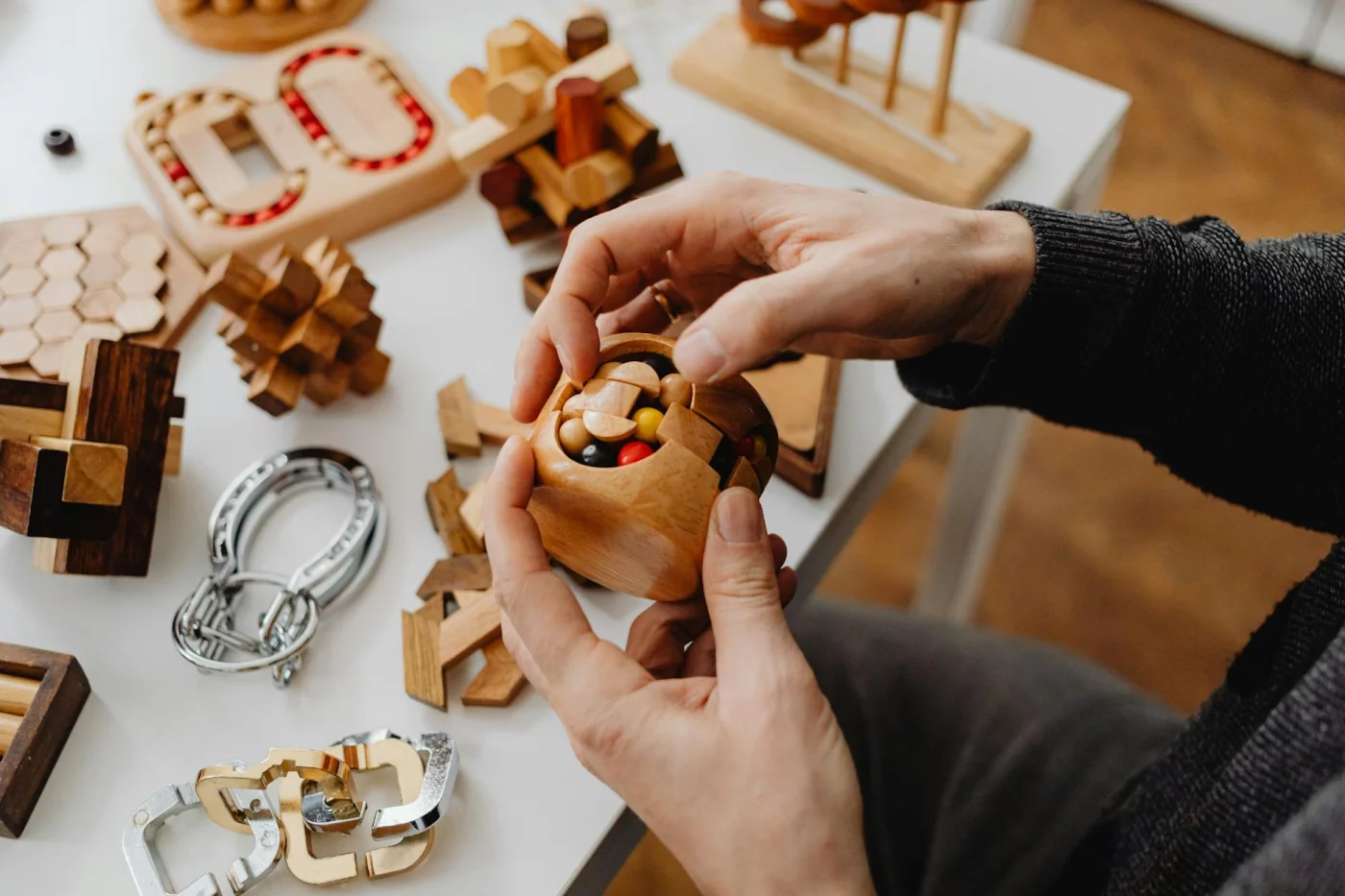
Most apps promise sharper thinking. But researchers don’t measure “feeling sharper” as a scientific outcome. They test specific abilities with controlled tasks, then check whether gains carry over into daily life. If you want broader habits that genuinely improve brain function and memory, that distinction matters a lot.
📋 Quick Reference
What apps claim: better memory, focus, mental speed, flexibility, and protection against decline.
What users hope for: fewer mistakes, better grades, stronger work performance, and easier everyday remembering.
What research usually supports: improvement on trained tasks and closely related tests, with weaker support for broad real-world benefits.
Confidence level: moderate for near transfer, low to mixed for far transfer.
- Working memory: holding and using information for a few seconds
- Processing speed: responding quickly on simple tasks
- Attention: staying focused and filtering distractions
- Executive function: planning, switching, inhibiting impulses, and staying on task
- Problem solving: reasoning through new patterns or rules
And here’s the kicker — many studies use different games, different training schedules, and different outcome measures. Ten minutes a day for three weeks is not the same as one hour a day for two months, so comparing the best brain games for adults across studies gets messy fast.
Common claims from apps like Lumosity
Apps like Lumosity usually market around memory, attention, flexibility, and speed. The pitch is simple: train core mental skills in short sessions now, and you’ll think better everywhere else later. Sounds great, right?
Well, actually, the broader scientific consensus is more cautious. There’s evidence that brain training apps can improve performance on the tasks you practice, but that’s not the same as proving large improvements in work, school, or daily functioning. That gap is one reason “lumosity does it work” and “are brain games effective” keep showing up in search results.
The public controversy didn’t come from nowhere. The U.S. Federal Trade Commission challenged exaggerated advertising claims around broad cognitive benefits, which pushed the field to be more precise about what training can and can’t do; even the American Psychological Association’s overview of cognitive training stresses that evidence varies by claim and population.
Personally, I think this is the part most people miss. The best brain games for adults are often sold as if they improve your whole mind, when the data usually support narrower effects.
The skills researchers actually measure
Researchers don’t just ask whether you “feel faster.” They use tasks designed to isolate specific abilities, often under tightly controlled conditions.
Working memory means holding information in mind briefly while doing something with it. Think remembering a short number sequence long enough to reverse it, or keeping track of where you are in mental math. If you’re a student, tools built around retrieval practice usually have a clearer path to academic performance than generic games, which is why I’d look at the best active recall apps before assuming the best brain games for adults will help you study better.
Processing speed is simpler: how quickly you can identify, compare, or react to basic information. That might mean tapping when a symbol appears or matching patterns under time pressure. Faster scores can be real, but they don’t automatically mean better judgment.
Executive function is broader. It includes planning, inhibition, task switching, and staying on track when distractions compete for your attention. According to a review in PubMed Central on cognitive training and transfer, the strongest effects tend to stay closest to the trained skill, while broad transfer is less consistent.
What users hope for vs what studies usually test
Here’s the mismatch. Users want better grades, fewer errors at work, easier meetings, and remembering appointments without effort. Studies often report changes in reaction time, digit span, task accuracy, or n-back performance.
That difference matters more than most rankings admit. If you get better at an n-back task, have you improved real-world cognition, or just learned the rules of that task? And if a study reports a statistically significant gain, will you notice it in your actual life?
A good comparison is the way people ask whether does speed reading actually work. The popular claim sounds broad and exciting, but the evidence gets more limited once you ask what outcome was measured and what tradeoff was hidden.
So yes, the best brain games for adults may sharpen performance on closely related exercises. But the benefits of brain training games are often narrower than the marketing suggests, especially when adults, students, and older adults all get grouped together as if they respond the same way. Which brings us to the next issue: getting better at the game itself is not the same as getting smarter.
Why getting better at a game is not the same as getting smarter
The last section covered the marketing gap. Now we need the real distinction most pages skip: improving on a trained task is not the same as improving your overall thinking.
That matters because many lists of the best brain games for adults quietly blur those two outcomes. And once you see the difference, the whole “do brain games make you smarter” debate gets much easier to judge.
Near transfer explained simply
Near transfer means practice helps you on tasks that are very similar to the one you trained. Same basic skill, similar rules, similar mental moves.
So if you do Sudoku every day, you may get better at Sudoku-like logic patterns. You might spot number constraints faster, hold possibilities in mind more efficiently, and make fewer repeated mistakes. That’s real progress. It’s just narrow progress.
The same thing happens in many apps marketed as the best brain games for adults. Practice a reaction-time mini-game, and you often improve on that mini-game or another one that uses similar speed-and-click demands. Train short-term memory tasks, and you may score better on related memory tests.
Research in cognitive psychology generally accepts that near transfer happens. Reviews often find gains on trained tasks and closely related tasks, especially when people get lots of repetition and feedback. If you’re wondering, “do brain training games work psychology-wise?” the honest answer is yes, for near transfer quite often.
But wait. That doesn’t mean the gains spread everywhere.
If you’re a student, this is where people get misled. Getting better at a memory game is not the same as learning course material better; methods like best active recall apps tend to map much more directly to test performance because they train retrieval of the actual content you need.
Far transfer and why it is harder to prove
Far transfer is the bigger claim. It means practice on one task improves broader abilities like everyday memory, school performance, work output, or aspects of fluid intelligence.
Example? Expecting Sudoku to help you write clearer reports, stay focused in long meetings, or learn calculus faster. Possible in theory. Harder to show in real life.
Why is far transfer so difficult to prove? Because real-world cognition is messy. Writing a good report depends on language skill, background knowledge, planning, sleep, stress, motivation, and attention control — not just one puzzle habit.
And here’s the kicker — many studies that support broad claims have limitations:
- Small sample sizes that make results unstable
- Short training periods, often just a few weeks
- Publication bias, where positive findings are more likely to appear
- Inconsistent outcome measures across studies
That’s why researchers lean on randomized controlled trials and meta-analyses instead of flashy before-and-after scores. A meta-analysis pools multiple studies to ask a tougher question: do benefits generalize beyond the trained task across different samples and methods? On far transfer, the answer across many reviews has often been mixed or weak.
For example, a large 2016 evidence report published through PubMed found that cognitive training can improve the specific skills people practice, but evidence for broad transfer to everyday functioning was limited. Personally, I think this is the part most people get wrong when comparing the best brain games for adults with genuine cognitive improvement.
What this means for adults in real life
So, are the best brain games for adults useless? No. If your goal is to get better at a specific game, sharpen a narrow skill, or enjoy a structured mental challenge, they can absolutely work.
But if your goal is better studying, fewer attention slips, stronger memory for real information, or long-term brain health, other habits usually have stronger support. Sleep, exercise, social engagement, learning demanding new skills, and managing stress affect real-world cognition more consistently than most game-based training. For a broader overview, see our guide on how to improve brain function and memory.
Students should be especially careful here. If you want better grades, strategies like active recall vs passive review usually have a clearer path to academic results than generic brain games. Same with adults trying to focus better at work — time structure, task design, and energy management often matter more than another app level.
Three takeaways matter:
- Near transfer is common and useful, but limited
- Far transfer is the big promise, and the evidence is much less convincing
- The best brain games for adults should be judged by your actual goal, not by marketing language
Which brings us to the next section: what the research actually says when you compare app claims, randomized trials, and meta-analyses side by side.
What the research says: Lumosity vs science, plus the biggest mistakes to avoid
So here’s the deal: if you want to judge the best brain games for adults, don’t start with ads, testimonials, or your app streak. Start with higher-quality evidence, because the real question isn’t “Did I get better at the game?” but “Did anything useful transfer beyond it?”

If you want a broader evidence-based view of habits that actually improve brain function and memory, that matters more than any leaderboard. And yes, that’s the standard the best brain games for adults should be held to.
What meta-analyses generally find
At the top of the evidence hierarchy, meta-analyses and well-designed randomized controlled trial studies matter most. Why? Because one flashy positive paper can be misleading, while pooled evidence shows the broader pattern across many studies and populations.
When researchers review brain-training studies indexed on PubMed, the pattern is pretty consistent: small to moderate gains often show up on the trained task itself, or on very similar tasks. That’s called near transfer. Far transfer — better grades, better job performance, better everyday memory, better reasoning across life — is much less consistent.
That distinction matters a lot for the best brain games for adults. If an app improves your speed on its own matching task, that’s real practice improvement. But wait. That alone doesn’t prove broader cognitive change.
Some reviews disagree, and there’s a reason. Different meta-analysis papers include different age groups, different training lengths, different control groups, and different outcome measures. A study using an active control and objective testing is usually more informative than one comparing training against doing nothing.
- Near transfer: getting better at the game or a closely related test
- Far transfer: improving real-world attention, memory, planning, or academic/work outcomes
- Best evidence: pooled reviews and randomized controlled trial designs, not isolated success stories
Personally, I think this is the part most people get wrong. They search for the best brain games for adults, but what they really want is better focus, memory, or mental sharpness in daily life.
Why expert groups remain cautious
Plain-English summaries from experts are useful here. APA’s brain game debate summary explains that scientists disagree on how much broad benefit current products deliver, while Harvard Health on brain-training games makes a similar point: practice can help you improve at practiced tasks, but claims about general brain improvement need stronger proof.
Now this is where it gets interesting. Skepticism is not the same as saying brain games do nothing. It means the evidence is stronger for “you’ll get better at the trained activity” than for “this will meaningfully upgrade your whole brain.”
So, are brain games effective? Sometimes, in narrow ways. But if you’re comparing options for the best brain games for adults, expert caution is really about inflated claims, not about whether repetition can improve performance.
Common mistakes and red flags to avoid
Mistake one: confusing engagement with effectiveness. A game can be fun, motivating, and habit-forming without being one of the best brain games for adults for real-life outcomes. Enjoyment matters, sure, but it isn’t proof.
Mistake two: trusting self-reports over objective outcomes. If people say they “feel sharper,” that’s interesting, not definitive. Better evidence comes from validated tests, daily functioning measures, or real performance changes.
Mistake three: ignoring bigger drivers of cognition. Sleep, exercise, stress load, social activity, blood pressure, and deliberate learning habits often have stronger evidence than commercial brain training. If your focus crashes in the afternoon, the issue may be physiology, not a lack of games — see why you cannot focus after lunch.
And here are the red flags I’d watch for when evaluating the best brain games for adults:
- Claims about preventing dementia or treating disease without strong clinical evidence
- Vague neuroscience language with no clear outcomes
- No mention of near transfer vs far transfer
- Heavy reliance on “brain age” metrics as if they were clinically meaningful
- One small study presented as settled science
One more thing. Adults, students, and older adults don’t always need the same solution. Someone trying to study better may benefit more from retrieval practice, while an older adult may care more about mobility, sleep, social engagement, and cardiovascular health than app scores.
Which brings us to the practical question: if the evidence is mixed, who actually benefits from brain training, and under what conditions? That’s what we’ll sort out next.
Do brain training games work for adults, students, and older adults? A real-world application guide
So here’s the practical follow-up to the research debate: the answer depends on who you are and what result you want. The best brain games for adults aren’t equally useful for workers trying to focus, students trying to raise grades, and older adults thinking about healthy aging.
A quick myth-vs-fact version? Getting better at a game is usually “near transfer” — improvement on similar tasks. Real-life gains in memory, attention, grades, or daily functioning are “far transfer,” and that’s where the evidence gets much weaker for many of the best brain games for adults.
Adults trying to stay sharp
Mini-verdict: yes, brain games can be fine for enjoyment and routine, but they’re usually not the strongest use of limited time if your goal is better focus, memory, or productivity. If you enjoy the best brain games for adults, keep them — just don’t expect them to outperform sleep, exercise, and deliberate learning.
Do brain training games work for adults in the real world? Sometimes, but mostly in the narrow sense that you improve at the trained task. This is the part most people get wrong: faster at a pattern game doesn’t automatically mean better at managing meetings, remembering names, or staying focused through deep work.
Try a simple comparison. You have 15 minutes. Should you spend it on one of the best brain games for adults, 15 minutes of brisk walking, or 15 minutes practicing a new language, instrument, or technical skill?
- If you want enjoyment and a mental routine, the game is reasonable.
- If you want brain health, brisk walking likely has broader upside.
- If you want real cognitive challenge, learning a skill gives you richer transfer.
Research on brain games vs exercise for brain health consistently gives exercise the stronger overall case, especially for mood, sleep quality, vascular health, and executive function. And yes, that sounds less flashy than an app, but it’s usually the better trade.
Personally, I’d pair any game habit with habits that actually move the needle: exercise, enough sleep, and ongoing learning. If your bigger goal is to improve brain function and memory, that combination tends to make more sense than relying on the best brain games for adults alone.
Students trying to study better
Mini-verdict: for exams and retention, brain games are usually a distraction from methods with much stronger academic payoff. Do brain training games work for students? Maybe as a fun warm-up, but feeling mentally “on” is not the same as learning biology, calculus, or history.
Well, actually, this distinction matters a lot. A student might feel sharper after five minutes of a game, but unless they retrieve course material from memory, they haven’t strengthened the knowledge they’ll need on the test.
What works better? Three things: active recall, spaced repetition, and interleaving. A 2013 review in Psychological Science in the Public Interest by Dunlosky and colleagues identified practice testing and distributed practice among the most effective learning techniques, with much stronger relevance to grades than generic cognitive games.
From experience, after building learning tools at FreeBrain, users tend to get more measurable results from retrieval practice systems than from generic mini-games. Quiz scores, recall speed, and retention over days are easier to track — and usually easier to improve.
Older adults worried about cognitive decline
Mini-verdict: brain games may provide engagement, structure, and enjoyment, but evidence for preventing cognitive decline is limited. For older adults, the best brain games for adults are best viewed as one optional activity, not a shield against dementia.
The broader healthy aging picture matters more: physical activity, sleep, social connection, hearing and vision care, blood pressure control, and staying mentally engaged. The National Institute on Aging guidance emphasizes these wider habits rather than promising that brain games can prevent decline.
Can brain games prevent cognitive decline? Evidence indicates that any effect is modest at best, and disease-prevention claims should make you skeptical. But wait — that doesn’t mean games are useless. If a puzzle app helps you stay consistent with a daily routine and keeps you engaged, that still has value.
Which brings us to the real decision: if brain games aren’t useless but also aren’t the strongest option, what should you do instead — or alongside them? That’s exactly what the next section covers in a simple 5-step plan.
Best brain games for adults vs better-supported habits: a 5-step plan and bottom line
So here’s the practical takeaway from the last section: the best brain games for adults can sharpen the exact task you practice, but that’s usually near transfer, not broad real-world improvement. If you want bigger gains in memory, focus, and daily performance, the evidence points first to habits and systems that support improve brain function and memory.

What has stronger evidence than brain games
Three things matter most: movement, sleep, and stress control. Research consistently links exercise and brain health, with regular aerobic activity associated with better executive function, mood, and processing speed; a 2023 review in the British Journal of Sports Medicine found moderate benefits across cognitive outcomes in adults. And sleep and cognition are tightly linked too, because memory consolidation happens during sleep, not during a puzzle app.
But wait. This is the part most people get wrong. Getting better at the best brain games for adults does not mean you’ll remember names better, study better, or make fewer mistakes at work.
- Exercise: stronger support for attention, mood, and long-term brain health habits
- Sleep: better recall, learning, and sustained focus
- Stress reduction: better executive control and fewer attention lapses
- Learning real skills: more meaningful transfer than generic drills
- Social engagement: linked with healthier cognitive aging in longitudinal research
How to test brain games without fooling yourself
How to test whether the best brain games for adults help you
- Step 1: Pick one real outcome: fewer missed tasks, better quiz scores, or longer focus blocks.
- Step 2: Track a 2-week baseline before changing anything.
- Step 3: Use the game 10–15 minutes a day for 4 weeks.
- Step 4: Compare real outcomes, not just app scores. Evidence-based memory improvement means daily-life results.
- Step 5: Stop if it cuts into sleep, exercise, study time, or social contact.
📋 Quick Reference
Best use of brain games: practice, enjoyment, short mental warm-ups.
Better-supported habits: exercise, sleep, stress management, learning useful skills, and evidence-based study methods.
Are brain games worth it? Sometimes — if they don’t replace higher-value habits.
Bottom line in plain English
The best brain games for adults may be useful as practice or entertainment. They are weak as a shortcut to intelligence, and these games won’t outperform sleep, exercise, or deliberate learning for everyday cognition. Worth it? Sure, if they fit around better-supported habits. Next, I’ll answer the most common questions and wrap this up clearly.
Frequently Asked Questions
Do brain training games work for adults?
If you’re asking do brain training games work for adults, the short answer is: yes, but mostly on the exact tasks you practice. Research reviews generally find that adults can get better at trained activities like speed, matching, or working-memory-style tasks, but evidence for broad gains in everyday memory, job performance, or general intelligence is much weaker. So even the best brain games for adults are better treated as optional mental practice tools than as your main strategy for improving how your brain works day to day.
Do brain training games work for students?
When people ask do brain training games work for students, I think the more useful question is what helps grades and long-term retention most. Generic games can feel productive, but they don’t directly train your course material the way retrieval practice, spaced repetition, and mixed practice do. For most learners, the best brain games for adults still won’t beat a solid study system, which is why students usually get more value from tools like FreeBrain’s Study Method Picker than from generic brain training alone.
Do brain games help with memory?
Do brain games help with memory? Sometimes, yes — but usually in a narrow way. They may improve the specific memory task you’re repeating, yet that doesn’t automatically mean you’ll remember names better, keep track of deadlines, or retain lecture material more easily. Even with the best brain games for adults, real-world memory tends to improve more from retrieval practice, spaced review, and good cue design than from game performance alone.
Do brain games make you smarter?
If you’re wondering do brain games make you smarter, current evidence doesn’t strongly support broad increases in intelligence from brain games by themselves. Most gains are task-specific, which means getting good at a game isn’t the same as improving fluid intelligence or problem solving across totally different situations. The best brain games for adults may sharpen familiarity and strategy inside the game, but that’s not the same thing as becoming broadly smarter.
Are brain training games actually doing anything?
Yes — if you’re asking are brain training games actually doing anything, they often improve a few real things: familiarity, speed, and strategy on similar tasks. But wait, that’s only half the story. The bigger issue is whether those gains transfer into daily life, and that’s where the evidence is mixed, so even the best brain games for adults should be judged by your actual goal, not by marketing claims.
Can brain games prevent cognitive decline?
Can brain games prevent cognitive decline? Evidence for prevention is limited, especially when compared with broader lifestyle factors that have stronger support. Guidance from major health sources puts more weight on exercise, sleep, social connection, and managing blood pressure, diabetes, and hearing loss; Harvard Health and other expert summaries stay cautious about giving brain games a major preventive role, even for the best brain games for adults. The National Institute on Aging has a useful overview, and if you or a family member notice meaningful memory changes, it’s smart to consult a qualified clinician.
Are brain games worth your time?
Whether are brain games worth it depends on what they’re replacing. They can be worth it for enjoyment, routine, or practicing a narrow skill, but they’re a worse trade if they crowd out sleep, exercise, focused learning, or stress management. So yes, the best brain games for adults can have a place in your routine — just not at the expense of habits that matter more.
What does research say about brain games?
If you want the honest answer to what does research say about brain games, it’s this: meta-analyses usually find modest improvements on trained tasks and weaker evidence for far transfer into everyday thinking. Expert summaries from groups like the American Psychological Association and Harvard Health remain careful about broad claims, which I think is the right stance. The best brain games for adults aren’t magic, but they’re not completely useless either — they’re just most useful when you see them as a small supplement rather than a full brain-improvement plan.
Conclusion: Use Brain Games as a Tool, Not a Shortcut
Here’s the practical verdict. The best brain games for adults can help you practice a narrow skill, stay mentally engaged, and make cognitive training feel more fun, but they’re not a shortcut to higher intelligence or broad real-world performance. If you want results that actually transfer, focus on four things: pick games tied to a specific goal, don’t confuse in-game improvement with general brain improvement, avoid apps that promise sweeping benefits without strong evidence, and spend more of your effort on better-supported habits like sleep, exercise, stress control, and active learning methods. That’s the part most people get wrong. They chase novelty when consistency matters more.
And honestly, that’s good news. You don’t need a perfect app or some expensive subscription to support your brain. You need a realistic system you’ll actually stick with. If a few of the best brain games for adults help you stay consistent, great — use them. But build them around habits that have stronger research behind them. Small, repeatable wins beat flashy promises every time.
Want to keep going? Explore more evidence-based strategies on FreeBrain.net, including Active Recall vs Passive Review and Spaced Repetition Guide. If you’re comparing the best brain games for adults with study methods that improve memory in everyday life, those are the next two pages I’d read. Start simple, test what works for you, and build a brain training plan that holds up outside the app.