Twenty minutes a day can be enough to build steady Spanish momentum if the session is structured. The practical 80/20 rule for learning Spanish is simple: spend most of your limited time on the words, sentence frames, listening practice, and recall work you are most likely to reuse.
This routine is for busy adults who cannot depend on long evening study sessions. Instead of opening several apps and deciding what to do each day, you will follow the same four-part loop: review, input, output, and one tiny next step for tomorrow.
Use the plan as a realistic baseline, not a fluency shortcut. You will see a 5-5-5-5 routine, a commute-day version, beginner and intermediate adjustments, common mistakes, and a weekly method for choosing the highest-value Spanish before the week starts.
In this article, I’ll give you an exact minute-by-minute routine for beginners and intermediate learners, plus Spanish and English examples you can copy today. You’ll also get direct answers to questions like is 20 minutes a day enough to learn a language, whether 30 minutes is better, how to study a language in 20 minutes, and how to turn the 80 20 rule for learning spanish into a daily study habit instead of a motivational slogan.
I’m a software engineer, not a neuroscientist — but I’ve spent years building FreeBrain tools and testing short, repeatable study systems for self-learners. So I’ll keep this practical: vocabulary review, listening practice, speaking practice, active recall, and a printable checklist structure you can pair with the best language learning apps without burning out.
📑 Table of Contents
- The 20-minute plan that fits real life
- Why 20 minutes can actually work
- Use the 80/20 rule for Spanish
- Your 20-minute routine, step by step
- Quick reference, mistakes, and weekly plan
- Frequently Asked Questions
- What is a 20 minute language learning routine?
- How do you study a language in 20 minutes a day?
- Is 20 minutes a day enough to learn a language?
- Is 30 minutes a day good for language learning?
- What is the 15 30 15 method of language learning?
- What is the 80 20 rule for learning Spanish?
- Can you learn Spanish with 20 minutes a day?
- Can you learn English with 20 minutes a day?
- Conclusion
The 20-minute plan that fits real life
So here’s the practical version. Yes, the 80 20 rule for learning spanish can work in just 20 minutes a day if each session has four parts: review, input, output, and one tiny follow-up task. For more on learning and study skills, see our learning and study skills guide.
The short answer
A solid 20 minute language learning routine looks like 5-5-5-5: 5 minutes review, 5 minutes listening or reading, 5 minutes speaking or writing, 5 minutes for a tiny next step. If your day is chaotic, use a 10-5-5 commute version instead. That’s the simplest answer to how to study a language in 20 minutes.
And yes, consistency beats intensity here. One focused daily block usually does more than a random 2-hour Sunday session because spaced repetition and retrieval practice work better with frequent exposure; that’s why active recall explained matters so much.
Why this is built for full-time workers
This plan is for people with jobs, commutes, and low evening energy. Personally, I think vague “study more” advice fails because decision fatigue is real; a preset routine removes the daily negotiation. If you’re juggling work already, our guide on study while working shows the same principle: small systems beat heroic plans.
As a software engineer building FreeBrain tools, I’ve seen compact routines outperform ambitious plans people quit after 5-7 days. Research on spaced repetition in learning and memory and the testing effect points in the same direction.
What you’ll get from this guide
I’ll show you how to apply the 80/20 rule for studying to Spanish with exact minute blocks, plus beginner and intermediate versions. You’ll also get Spanish and English examples, a printable-checklist mindset, and tool suggestions like these best language learning apps for flashcards, audio, and speaking practice.
- Beginner: high-frequency words and survival phrases
- Intermediate: listening, sentence patterns, and output
- Busy days: minimum viable routine you can still finish
Realistic expectations? The 80 20 rule for learning spanish helps you progress steadily, not magically become fluent in a month. And quick note: if stress, burnout, sleep problems, or attention issues are seriously affecting learning, consult a qualified professional. Which brings us to the next question: why can 20 minutes actually work so well?
Why 20 minutes can actually work
A 20-minute plan sounds small. But for the 80 20 rule for learning spanish, small done daily beats big done randomly almost every time.

Consistency beats intensity
Here’s why: 20 minutes a day gives you 140 minutes a week. One 2-hour weekend cram session gives you about the same total time, but far fewer chances to remember, forget a little, and retrieve again.
That matters because memory gets stronger when you come back to material repeatedly, not just when you stare at it once. And yes, is 20 minutes a day enough to learn a language? For steady progress, usually yes. It’s also easier to repeat a short block than a 90-minute one, especially if you’re busy or trying to study while working.
The science behind each block
A simple 5-5-5-5 routine works well:
- Review 15-25 flashcards with spaced repetition and active recall explained
- Listen to 3-5 minutes of understandable audio
- Say 5-10 sentences aloud
- Save 1 useful sentence for later review
Passive exposure helps, but retrieval practice is what improves access. Research discussed in NCBI’s overview of learning and memory and habit guidance from the American Psychological Association on healthy habits supports that pattern: frequent review, low friction, better retention. If you want tools for flashcards and audio, start with these best language learning apps.
When 30 minutes is better
If you’re preparing for travel, an exam, or faster speaking gains, 30 minutes is better. Add 10 extra minutes of listening or conversation, then apply the same logic you’ll use in the 80/20 rule for studying. Which brings us to the next step: using the 80 20 rule for learning spanish on purpose.
Use the 80/20 rule for Spanish
If 20 minutes works, the next question is obvious: what should fill those 20 minutes? The 80 20 rule for learning spanish means spending most of your effort on the small set of words and patterns you’ll actually use every day, much like the broader 80/20 rule for studying.
What the high-value 20% looks like
For beginners, that high-value chunk is usually 100-300 common words, 10-15 core verbs, question words, pronouns, and connectors. Think greetings, numbers, time, quién/qué/dónde/cuándo, and verbs like ser, estar, tener, ir, hacer, poder, querer, and necesitar.
- Sentence frames: Quiero…, Necesito…, ¿Dónde está…?, Voy a…, Me gusta…, Tengo que…
- Daily situations: ordering food, introducing yourself, commuting, work small talk
This is the 80 20 rule for language learning beginners in practice. Research on retrieval-based learning in the National Library of Medicine suggests repeated recall strengthens retention, so high-frequency material gives you more chances to remember it. And yes, the same logic works for English learners too. If you want tools for flashcards, audio, and speaking, start with these best language learning apps.
What to ignore for now
Don’t start with rare nouns, niche themes, or every conjugation table in week one. Personally, I think this is where most learners lose learning efficiency: too much grammar review, not enough usable Spanish.
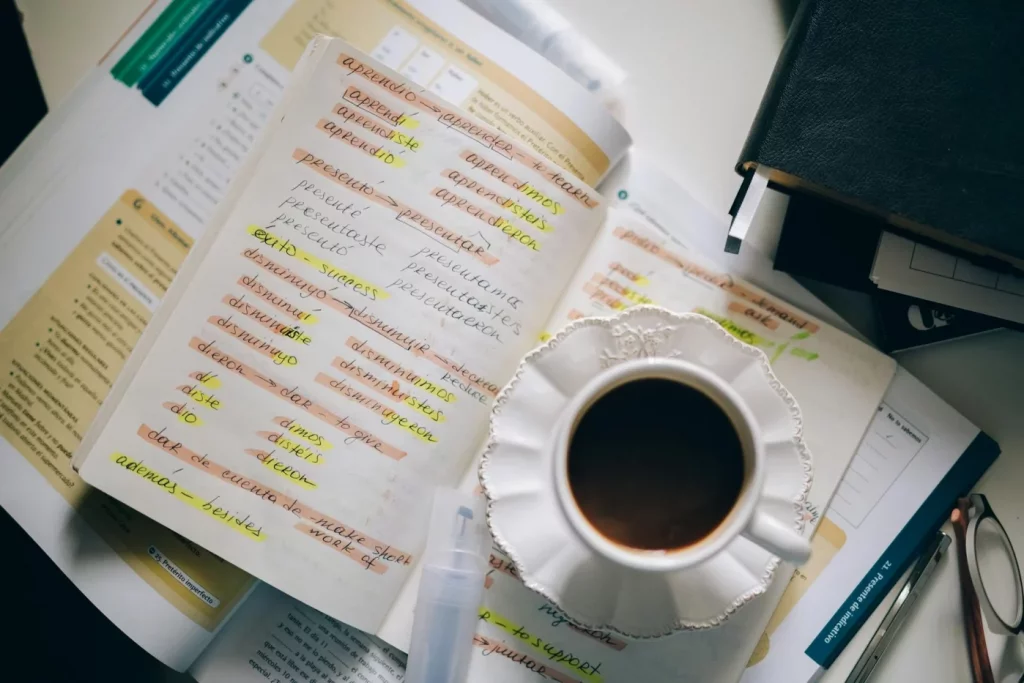
Color-coded notes feel productive. But wait, they often replace retrieval practice, which is why active recall explained matters more than prettier notes. Even Zipf’s law on word frequency points to the same idea: a small number of common words appear again and again.
From experience: what busy learners stick with
After building study systems for self-learners, I’ve noticed something simple. People stay consistent when a session starts with known material and ends with one saved sentence, not a vague plan to “study Spanish.”
Beginners should hammer core words and sentence frames. Intermediates shift toward more listening volume, connectors like aunque and entonces, and topic-specific vocabulary. Short routines usually fail for three reasons: too many apps, too many new words, or no speaking at all. Which brings us to the next section: exactly how to structure your 20 minutes.
Your 20-minute routine, step by step
So here’s the deal: the 80 20 rule for learning spanish only works if you turn it into a repeatable daily loop. And yes, 20 minutes is enough to make progress when you focus on retrieval, input, and output instead of random app tapping.
If you need tools, start with a few of the best language learning apps, then keep the session tight. Research on retrieval practice, summarized well in active recall explained, lines up with what the American Psychological Association says about memory: recall beats rereading.
The 5-5-5-5 routine
Use 5-5-5-5 as a fixed loop, not a menu. The point is to remove choices so you can start even when you are tired.
- Minutes 1-5: review. Recall yesterday’s cards or sentences before looking. Use prompts such as Where is the station? and answer with ¿Dónde está la estación?
- Minutes 6-10: input. Listen to or read a short, easy clip. Replay it once and catch three known words, one verb pattern, or one useful connector.
- Minutes 11-15: output. Say five to ten short sentences aloud. If speaking feels awkward, read aloud first, then repeat one line without looking.
- Minutes 16-20: save one sentence. Choose one line you would actually use tomorrow, write a short English cue, and add it to your next review.
Use this decision rule: if you cannot produce yesterday’s sentence from memory, do not add five new items. Repeat the sentence, change one word, and save the new version. For example, change Quiero ir al hotel to Quiero ir a la estación. That is still progress because you are making a reusable pattern easier to retrieve.
How to do the 20-minute spanish study routine
- Step 1: Minutes 1-5: review 10-20 flashcards or yesterday’s lines from memory. Spanish: “¿Dónde está la estación?” English: “Where’s the station?”
- Step 2: Minutes 6-10: play 3-5 minutes of easy audio, then replay once and catch 3 known words or 1 pattern. Spanish: “quiero + infinitive.” English: “I want to go.”
- Step 3: Minutes 11-15: do speaking practice, read aloud, or use the shadowing technique with 5-10 short lines. Focus on rhythm, not perfection.
- Step 4: Minutes 16-20: mine 1 useful sentence and write 1 tiny grammar note for tomorrow. That’s the core of the 80/20 rule for studying in language form.