
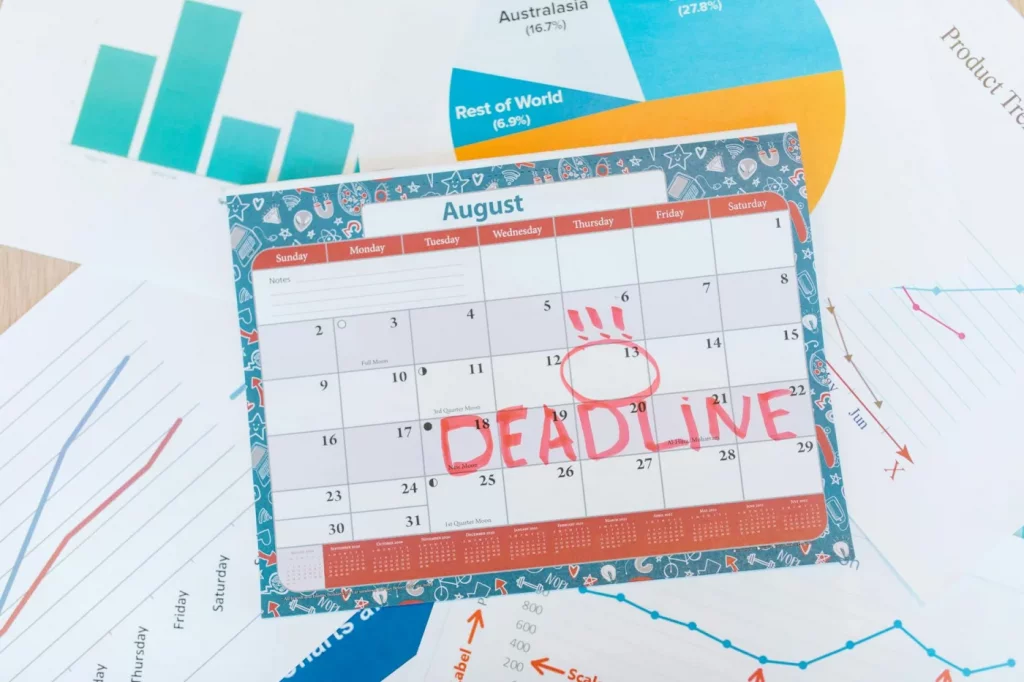
You can do amazing work at the last minute. But you can’t keep living there. The importance of meeting deadlines at work isn’t about being “disciplined” — it’s about trust, coordination, and the compounding cost of delays that quietly wreck projects.
And yes, the importance of meeting deadlines at work shows up fast: missed handoffs, rushed quality checks, awkward stakeholder updates, and that constant low-grade dread. If you want a practical system you can actually use this week, start with FreeBrain’s Focus & Productivity Tools while you read.
Here’s the weird part: you’re not lazy — your brain is just responding to time. Why do you only work under pressure, even when you care? Because as the deadline gets close, the task suddenly feels more “real,” your attention snaps into place, and urgency finally beats distraction.
That’s temporal discounting and present bias in action — the future reward feels small until it’s basically now. (If you’ve ever pulled an all-nighter and felt strangely focused, you’ve met this mechanism.)
This article gives you a neuroscience-first “Deadline Design Framework” that creates urgency earlier without panic. You’ll get a time-to-deadline intervention table (what to change at 30 days vs 7 days vs 24 hours), milestone spacing rules, micro-deadlines that don’t backfire, and feedback cadence that keeps you moving.
And because the importance of meeting deadlines at work looks different for different people, you’ll also see examples for students (exam runway and spacing), solo professionals, and teams — plus a short video script outline and visual ideas built for featured snippets. Students, you’ll want to pair the framework with FreeBrain’s Learning & Study Tools to replace cramming with smarter milestones.
Quick credibility note: I’m a software engineer who builds learning tools, and I’ve spent an embarrassing number of hours testing what actually changes task initiation and follow-through. We’ll ground the “why” in established models like Temporal Motivation Theory (overview) — then translate it into deadlines you can live with.
Bottom line: the importance of meeting deadlines at work is real, but burnout doesn’t have to be the price of admission.
📑 Table of Contents
- Why deadlines work (and fail): psychology of deadlines and procrastination
- What happens in the brain when a deadline is near (dopamine, PFC, cortisol)
- Temporal Motivation Theory explained simply + the time-to-deadline table
- The importance of meeting deadlines at work: trust, coordination, and quality
- Common deadline mistakes to avoid (deadline anxiety + procrastination cycle)
- Deadline Design Framework: step-by-step system + artificial deadlines that work
- Frequently Asked Questions
- Conclusion
Why deadlines work (and fail): psychology of deadlines and procrastination
In the intro, we talked about why the importance of meeting deadlines at work isn’t just “be professional” advice—it’s a system problem. Now let’s look at the psychology of deadlines and procrastination, because deadlines can create urgency, but they can also train you into last-minute chaos. For more on productivity and focus, see our productivity and focus guide.
Here’s the deal: the importance of meeting deadlines at work often gets framed as willpower, when it’s usually emotion + attention + friction. If you want a practical way to test small changes (micro-deadlines, calendar slots, review loops), start with our Focus & Productivity Tools.
Procrastination has a surprisingly crisp definition. The APA Dictionary of Psychology definition of procrastination describes it as the tendency to delay tasks even when you expect the delay will hurt you. That “even when” matters, because procrastination is usually a self-regulation problem: you’re regulating feelings (boredom, uncertainty, fear of doing it wrong), not time.
And yes, students fall into the same trap. If an exam is six weeks away, present bias and temporal discounting make the reward of studying feel tiny today—until the test becomes immediate and emotionally loud. If you want to build a longer “runway” with spaced practice instead of cramming, use the Learning & Study Tools to set weekly checkpoints.
Intention vs action: planning fallacy + task initiation friction
Why do you “only work under pressure”? Well, actually… you often intend to start, but you can’t cross the action threshold. That gap is task initiation friction: the invisible effort needed to begin, especially when the task is vague.
Two forces collide here. First, the planning fallacy: we underestimate how long complex work takes, especially when it includes reviews, back-and-forth, and waiting on others. Second, executive function has to translate intention into a first move, and ambiguity makes that translation costly.
Try this example. “Write the Q2 report” feels like a foggy mountain, so you avoid it; “open the doc + write 3 bullet points you already know” is concrete, so you start. That’s an implementation intention in plain language: when it’s 9:00, then I open the file and write three bullets.
- Vague: “Work on the presentation.”
- Next action: “Open slides, duplicate last deck, write the 5 section headers.”
- Uncertainty reducer: “List 3 questions to ask your manager so you don’t build the wrong thing.”
This is the part most people get wrong: uncertainty multiplies delay. If you’re not sure what “done” looks like, starting feels risky, so your brain picks safer tasks (email, Slack, “quick wins”). And that’s where the importance of meeting deadlines at work quietly turns into a daily initiation problem, not a character flaw.
The urgency cycle: late motivation spikes—and what it costs
Let’s define the urgency cycle with a common workplace loop. Monday: low urgency, so you tell yourself you’ll start “after lunch.” Tuesday and Wednesday: avoidance, because the task still feels far away and unclear. Thursday: guilt (and a bit of deadline anxiety), because now it’s close enough to sting. Friday: panic sprint, then relief, then repeat next week.
Notice the reward. It’s not productivity; it’s relief—your nervous system getting a break from the negative feelings you were avoiding. Which brings us back to the importance of meeting deadlines at work: if your system trains you to rely on relief as the payoff, you’ll keep waiting until it hurts enough to move.
The costs aren’t just “stress.” They’re operational:
- Rework: rushed output creates “quality debt,” where you pay later in bug fixes, edits, and stakeholder churn.
- Missed dependencies: you finish your piece, but legal, design, or QA needed 24–72 hours you didn’t budget.
- Hidden coordination time: handoffs, reviews, and approvals often take longer than the work itself.
But wait—deadlines still help. Evidence from temporal motivation theory research suggests motivation rises as time-to-deadline shrinks because the deadline becomes more salient and the “now” reward finally feels real (see the overview on Temporal motivation theory). That’s why the importance of meeting deadlines at work is also about designing earlier salience, not praying for last-minute adrenaline.
If deadline anxiety is spiking, downshift fast before you “panic plan.” Use the Box Breathing Timer for 2–3 minutes, then pick one next action you can finish in 10 minutes. Worth it? Yes, because urgency is partly a salience/stress response, not a moral trait—and that’s exactly what we’ll unpack in the next section.
From Experience: what FreeBrain tool data tends to show
After building FreeBrain tools and watching anonymized usage patterns, a repeatable trend shows up: micro-deadlines + a weekly review tends to pull starts earlier and reduce “all-nighter” behavior. OK wait, let me back up—people don’t magically become disciplined; they make the deadline feel sooner by adding checkpoints.
Another pattern: the moment a task gets a specific calendar slot, completion rates tend to improve. Not because time blocks are perfect, but because they lower task initiation friction and force a decision about what “starting” means.
So here’s the practical frame. The importance of meeting deadlines at work is highest when deadlines are designed, not just assigned: reduce uncertainty, create earlier feedback, and make the first step tiny. Next, we’ll zoom into what’s happening in the brain as the deadline gets near—dopamine, prefrontal control, and cortisol-driven urgency.
What happens in the brain when a deadline is near (dopamine, PFC, cortisol)
In the last section we saw why deadlines can flip you from “later” to “now.” Here’s what’s happening under the hood—and why the importance of meeting deadlines at work isn’t just cultural, it’s biological attention math.

As the clock shrinks, your brain treats the task as more urgent, more rewarding, and more risky to ignore. That can be useful. Or it can push you into stress-driven tunnel vision. If you want a practical way to shape that urgency earlier, start with Focus & Productivity Tools.
Dopamine, salience, and reward prediction error: why ‘now’ wins
Deadlines create salience. Thing is, salience isn’t “motivation” in a pep-talk sense; it’s the feeling that a stimulus got louder in your attention system because outcomes suddenly changed.
One mechanism researchers talk about is reward prediction error: a signal that the expected payoff (or penalty) shifted. When a deadline moves from “weeks away” to “two days,” your expected outcome changes fast—miss it and you pay a real cost—so attention and action tend to spike. If you want the research rabbit hole, see PubMed Central papers on reward prediction error and dopamine.
But wait—dopamine isn’t an on/off switch, and procrastination isn’t a “low dopamine” diagnosis. Research suggests dopamine systems are involved in learning what’s worth acting on, especially when uncertainty and timing change, which is why the importance of meeting deadlines at work often becomes emotionally vivid right near the finish line.
Practical translation: don’t wait for the natural spike at T-48 hours. Create earlier “salience spikes” on purpose using:
- Visible milestones (a checklist that’s public to you or your team)
- External check-ins (a 10-minute review with a peer every 3–4 days)
- Smaller stakes (ship a draft, not perfection, to reduce uncertainty)
For students, it’s the same brain rule. Your exam feels “real” when retrieval practice exposes gaps, so schedule those gaps early with Learning & Study Tools instead of relying on last-week panic.
PFC + ACC under time pressure: focus vs tunnel vision
When the deadline closes in, your prefrontal cortex (PFC) has to do more executive work: plan, inhibit distractions, switch tasks, and hold goals in mind. Quick sidebar: that bundle is often called executive function, and the APA’s overview is a solid baseline: American Psychological Association explainer on executive function.
Meanwhile, the anterior cingulate cortex (ACC) helps with conflict monitoring—spotting “this is off track” or “two goals are colliding.” Under pressure, that combo can sharpen focus. Or it can narrow it too much.
This is the part most people get wrong. The importance of meeting deadlines at work can trick your brain into optimizing for “done” while silently dropping “aligned.” Example: you crank a feature to hit Friday, but you skip stakeholder alignment, so Monday becomes rework week.
Two tools reduce tunnel vision without slowing you down:
- Definition-of-done: 3–5 bullets (tests pass, reviewed by X, meets requirement Y).
- Pre-mortem: ask “If this misses, what will be the cause?” and patch the top 1–2 risks.
Personally, I think this is where the importance of meeting deadlines at work turns from “work ethic” into “system design.” You’re not trying harder; you’re steering executive control toward the right target.
Stress arousal and performance: Yerkes–Dodson (helpful vs harmful)
Deadlines also change arousal. The Yerkes–Dodson law is the classic idea: performance often improves with stress up to an optimal point, then drops when stress gets too high.
In the “helpful urgency” zone, you’ll notice steady focus, fewer context switches, and faster decisions with fewer second-guesses. In overload, you’ll see the opposite—and cortisol is one piece of the stress response that can rise with perceived threat and uncertainty. For a deeper read on stress physiology, PubMed Central’s collection is a good starting point: PubMed Central papers on cortisol and the stress response.
Here are practical overload markers you can actually track:
- Sleep loss you “borrow” for multiple nights
- Rumination (replaying the same worry loop, not solving)
- More errors in easy steps (copy/paste mistakes, missed fields)
- Irritability and short fuse in messages
OK wait, let me back up: the goal isn’t zero stress. It’s a stress ceiling you don’t cross, because overload makes the importance of meeting deadlines at work backfire—avoidance, sloppy output, and recovery days.
Which brings us to the next section: a simple model (Temporal Motivation Theory) that explains why urgency spikes as time-to-deadline shrinks—and how to map that change with a time-to-deadline table.
Temporal Motivation Theory explained simply + the time-to-deadline table
In the last section we talked about what happens in your brain as a deadline gets close: dopamine spikes, the prefrontal cortex gets squeezed, and cortisol can push you into “panic mode.” Temporal Motivation Theory explains why that curve happens so reliably—and why the importance of meeting deadlines at work often feels abstract until it’s suddenly urgent.
So here’s the deal. Temporal Motivation Theory says motivation isn’t a personality trait; it’s a moving math problem you can design around, which is exactly how I build deadline systems inside our Focus & Productivity Tools.
The TMT formula in plain English (value, expectancy, delay, impulsiveness)
Temporal Motivation Theory explained simply: you act when the task feels valuable and doable, and when the payoff isn’t too far away or too easy to trade for a quick distraction. In TMT terms, motivation goes up with value and expectancy, and down with delay and impulsiveness. That’s why the importance of meeting deadlines at work can be obvious in your head, yet still lose to Slack, email, or “just one more tab.”
Here’s what each lever looks like at work:
- Value: impact, recognition, money, learning, or reducing future pain. Example: “This report influences next quarter’s budget.”
- Expectancy: your confidence you can succeed. Example: “I know exactly how to outline it and what ‘done’ looks like.”
- Delay: time until the reward (or consequences). Example: “The review meeting is in 3 weeks, so today doesn’t ‘count’.”
- Impulsiveness: how strongly you chase immediate rewards. Example: “I’m tired, so I’ll take the easy dopamine: scrolling.”
But wait. Delay doesn’t just “reduce motivation”—it warps your perception through temporal discounting and present bias, the brain’s “far away feels fake” effect. If you want the underlying concept, Wikipedia’s overview of temporal discounting is a clean starting point, and it maps well to what you feel when a deadline is 30 days out.
Quick sidebar: “just try harder” fails when expectancy is low. If you don’t believe you can start cleanly, you’ll protect your ego by delaying—especially when the importance of meeting deadlines at work raises the stakes and makes failure feel expensive.
And yes, this applies to most people, not just ADHD. ADHD can amplify impulsiveness and time-blindness, but the general mechanism—reward prediction favoring now over later—shows up broadly in healthy adults too.
Deadline Motivation Model: what to do at 30d, 14d, 7d, 48h, 24h
Deadlines create motivation and urgency when you convert one far-away date into micro-deadlines with feedback. The goal isn’t constant pressure; it’s spacing milestones close enough to feel real, but not so close you live in panic. That balance is a big part of the importance of meeting deadlines at work: you’re protecting quality and your team’s nervous system.
| Time to deadline | Typical behavior | Risk | Best intervention |
|---|---|---|---|
| 30d | Vague planning, “I’ll start soon.” | Scope creep; false calm. | Define “done” + first milestone. Students: map exam topics; start retrieval plan via Learning & Study Tools. Knowledge workers: outline deliverable + owner review date. |
| 14d | Busywork, research loops. | No structure; low expectancy. | Draft skeleton. Students: build a “weak areas” list; schedule 3 micro-deadlines. Knowledge workers: create headings, data slots, and open questions. |
| 7d | Real work starts; urgency rises. | Cramming; quality swings. | First full pass. Students: do timed practice + error log. Knowledge workers: write the ugly draft; request early feedback to cut uncertainty. |
| 48h | Sprint mode, long hours. | Anxiety spiral; missed bugs. | QA/review checklist. Students: mixed practice + sleep protection. Knowledge workers: peer review, test cases, and a “red team” pass. If your body is stuck in threat mode, downshift fast with the Box Breathing Timer. |
| 24h | Polish + second-guessing. | Last-minute chaos; no buffer. | Final polish + buffer. Students: pack materials; stop new studying. Knowledge workers: format, citations, export checks, and send early to avoid fire drills. |
If you want a simple way to place these micro-deadlines on your calendar, use the Time Blocking templates right after you set the 30d and 14d milestones.
📋 Quick Reference
Raise value: tie the task to impact, reputation, or a concrete reward.
Raise expectancy: shrink the next step until you’re sure you can do it.
Reduce delay: add micro-deadlines (30d → 14d → 7d → 48h → 24h).
Reduce impulsiveness: change the environment (blocks, phone out of room) and add commitment (public check-ins).
Make the next step stupidly easy (expectancy booster)
The fastest expectancy boost is an implementation intention: “If it’s 9:00, then I open the doc and write 5 lines.” OK wait, let me back up. You’re not promising a full work session; you’re removing the decision, which is why setting deadlines helps with procrastination even when motivation is low.
Use a 2-minute start to cut initiation friction. Example: open the file, paste the outline, and write one ugly bullet under each heading—then stop if you want. Oddly enough, you usually won’t stop, and the importance of meeting deadlines at work starts showing up as calm progress instead of late-night adrenaline.
If you want the research basis for why “now rewards” dominate “later rewards,” a review on delay discounting in the National Library of Medicine (PMC) is a solid reference point.
Which brings us to the next section: how the importance of meeting deadlines at work isn’t just personal productivity—it’s trust, coordination, and quality for everyone downstream.
The importance of meeting deadlines at work: trust, coordination, and quality
Now that you’ve got Temporal Motivation Theory and the “time-to-deadline” curve in your head, here’s the real-world punchline: the importance of meeting deadlines at work isn’t about being “responsible.” It’s about reducing coordination costs and keeping feedback loops tight so the whole system doesn’t wobble.

Deadlines are also commitment devices. They turn vague intent into a time-bound promise, which is why teams that hit dates need fewer check-ins and fewer “where are we?” messages. If you want a practical way to turn that into daily execution, start with Focus & Productivity Tools and build your week around visible milestones.
Trust and reputation: why deadlines are social contracts
The importance of meeting deadlines at work shows up first as trust. When you consistently deliver on time, reliability becomes the default assumption—so your manager stops hovering and you get more autonomy. Miss dates often enough, and “just checking in” turns into micromanagement.
Picture two engineers with equal skill. One hits dates with boring consistency; the other is “usually close.” Who gets the high-trust project with fewer meetings, more creative freedom, and direct stakeholder access? The reliable one, because deadlines are a social contract, not a personal preference.
Accountability makes that contract visible. Three simple structures do most of the work:
- Clear owners (one name per deliverable, not “the team”)
- Shared calendars with milestone dates (draft, review, final)
- Short written updates tied to milestones (what changed, what’s blocked, what’s next)
And yes, this is why the importance of meeting deadlines at work compounds over time: your reputation becomes a coordination shortcut. People assume you’ll deliver, so they plan with less buffer and give you higher-leverage work.
Coordination math: handoffs, dependencies, and compounding costs
Here’s the part most people miss. A late task isn’t just “late”—it creates hidden work: re-planning, rescheduling, stakeholder updates, and context switching. Each of those has a real cost, even if it never shows up on a timesheet.
Try this dependency chain example. Your slide deck is one day late, so your manager can’t review it; the client call gets pushed; procurement can’t start; the contract signature slips into next week. One small slip becomes a multi-team delay, and the importance of meeting deadlines at work becomes painfully obvious when a $50 task blocks a $50,000 decision.
A practical metric I like is “dependency touchpoints affected.” When you slip, count how many other people or systems have to adjust:
- 1 touchpoint: only you (low coordination cost)
- 3 touchpoints: you + manager + one stakeholder (medium)
- 10+ touchpoints: cross-team, client-facing, or launch-critical (high)
Now this is where it gets interesting. Micro-deadlines shrink the blast radius because they reduce surprise and tighten feedback loops: draft by Tuesday, review by Thursday, final by Friday. Which brings us to students for a second—exams are just dependency chains with your future self—so using Learning & Study Tools to set weekly retrieval and practice milestones beats last-minute cramming almost every time.
Quality vs speed: when urgency helps—and when it backfires
Deadlines can improve work. But only under the right conditions: clear scope, short tasks, and fast feedback. Urgency raises arousal and attention, which can sharpen execution when you already know what “done” looks like.
But wait—when the work is complex or requirements are fuzzy, urgency often backfires. Stress climbs, executive control gets noisier, and you start trading thinking for reacting; the American Psychological Association’s overview of stress effects is a useful reference for why chronic pressure can impair decision-making and performance. That’s the darker side of the importance of meeting deadlines at work: if your process creates constant panic, quality drops and rework rises.
So here’s the deal: use a Pareto lens early. Define the 20% that drives 80% of value (see the Pareto Principle (80/20)), ship that first, then polish if time remains. It’s not “lower standards”; it’s sequencing value.
OK wait, let me back up with a concrete “definition of done” for a report. Before you start, write:
- Audience: VP of Sales
- Decision needed: approve pricing change (yes/no)
- Max length: 4 pages + 1-page appendix
- Data sources: CRM export + Q4 invoices
- Review steps: peer check Tuesday, manager review Thursday
Those details are implementation intentions in plain language: “If it’s Tuesday 2pm, I’ll send the draft for peer review.” And when anxiety spikes close to the date, a fast downshift like Box Breathing Timer can help you regain enough control to execute the next step cleanly.
Missed deadlines usually aren’t moral failures—they’re design failures: vague scope, no milestones, and feedback arriving too late. Next, we’ll walk through the most common deadline mistakes that trigger the procrastination-and-anxiety cycle, and how to avoid them.
Common deadline mistakes to avoid (deadline anxiety + procrastination cycle)
Once you understand the importance of meeting deadlines at work for trust and coordination, the next question is simpler: what’s quietly sabotaging you before the due date even arrives? Most deadline failures aren’t “laziness” problems; they’re design problems that trigger a predictable anxiety-procrastination loop.
So here’s the deal. If you keep falling into “why do I only work under pressure,” you don’t need more pressure—you need better structure, clearer stakes, and a calmer on-ramp to action. That’s exactly what our Focus & Productivity Tools are built to support: turning fuzzy work into visible milestones you can actually execute.
Mistake 1–3: vague ‘done’, one giant deadline, and no feedback cadence
Mistake #1 is “vague done.” “Finish the report” sounds clear, but your brain can’t plan it because the deliverable, audience, and constraints are missing—and uncertainty is gasoline for avoidance.
Here’s what vague vs. specific looks like:
- Vague: “Prepare Q2 update.”
- Specific: “Send a 6-slide deck to the VP by Thu 3pm: 3 metrics, 2 risks, 1 recommendation, using last quarter’s template.”
This is the part most people get wrong. They treat clarity as “nice to have,” but it’s directly tied to the importance of meeting deadlines at work because clarity reduces rework, delays, and last-minute quality drops.
Mistake #2 is one giant deadline. Research on temporal discounting and motivation (a core idea behind Temporal Motivation Theory) suggests that when rewards feel far away, early effort feels “not worth it,” so you delay until the payoff is imminent; Steel’s overview of procrastination research summarizes this pattern well (PubMed: Steel (2007) on procrastination).
Mistake #3 is no feedback cadence. Without feedback loops, you don’t get error signals early, so you don’t adjust until the deadline is close—when changes are expensive.
Fix all three with visible milestones and a weekly review. Aim for 3–7 checkpoints, each producing a concrete artifact (outline, first draft, stakeholder questions, final polish), because that’s how to create urgency without stress: small stakes, frequent signals, low uncertainty.
Mistake 4–6: artificial deadlines with no stakes, overbooking, and panic scheduling
Mistake #4 is “I’ll pretend it’s due Wednesday.” Well, actually… your brain usually knows it’s pretend. If nothing changes externally (a meeting, a handoff, a dependency), there’s no consequence, so the deadline won’t create real urgency.
Mistake #5 is overbooking. When deadlines collide, stress rises, sleep gets squeezed, and executive control gets worse; chronic stress is also linked with sustained cortisol elevation, which can impair cognition and mood over time (APA: stress effects on the body). And yes, that hits quality—right where the importance of meeting deadlines at work matters most.
Mistake #6 is panic scheduling: you ignore the project for days, then “solve” it with a heroic 10-hour block. It feels productive, but it’s mostly avoidance plus adrenaline, and it trains the deadline anxiety and procrastination cycle to repeat.
What works better are commitment devices and buffers. Three practical options:
- Irreversible scheduling: book a review meeting or stakeholder preview that forces a draft to exist.
- Public commitments: send a short note: “You’ll have v1 by Tuesday 11am.”
- Buffers: plan “done” 24–48 hours early to absorb surprises without panic.
Do you see the shift? You’re not trying to feel stressed on purpose; you’re making progress unavoidable while protecting quality—because the importance of meeting deadlines at work is really the importance of meeting deadlines with standards.
Breaking the cycle: fast downshift + next-action planning
When panic hits, your goal isn’t to “be calm.” It’s to downshift just enough to think, then take the smallest real step.
The loop usually goes: avoidance → relief → guilt → panic. Avoidance gives short-term relief (negative reinforcement), which teaches your brain to avoid again; then as the deadline closes, stress arousal spikes and cortisol can rise, making focus feel harder and “why do I only work under pressure” feel true.
Try this rapid reset for stress management—60 to 120 seconds total:
- Box breathing: 4 seconds inhale, 4 hold, 4 exhale, 4 hold. Use the Box Breathing Timer and do 4 rounds.
- Cognitive reappraisal: tell yourself, “This is information, not danger.” Then name the constraint: “I need a draft, not perfection.”
- Next-action planning: write one physical next action you can do in under 2 minutes: “Open doc and paste the outline,” or “Email Sara for the metric.”
Quick sidebar: this isn’t just an ADHD thing. Even without ADHD, reward prediction error and uncertainty can keep motivation low until time pressure increases arousal; with ADHD, the same dynamics can be amplified by differences in executive control and reward processing—so the design needs to be even more explicit.
And here’s the kicker — when you break the deadline anxiety and procrastination cycle early, the importance of meeting deadlines at work stops feeling like a moral test and starts feeling like a system you can run. Next, we’ll turn these fixes into a repeatable Deadline Design Framework, including artificial deadlines that actually work.
Deadline Design Framework: step-by-step system + artificial deadlines that work
The procrastination + anxiety loop usually isn’t a “motivation problem.” It’s a deadline design problem that fails to create early feedback, clear stakes, and a realistic runway.

This framework is built for the importance of meeting deadlines at work without relying on panic, and it’s repeatable across projects once you’ve run it a few times. If you want a simple place to run the experiment and track it, start with Focus & Productivity Tools and keep the setup consistent for one week.
How to do a 30-minute deadline reset (one project)
So here’s the deal. You’re going to redesign one deadline in 30 minutes, using implementation intentions (“If it’s 9:00, then I start the outline”) and micro-deadlines that force early proof of progress.
How to do a 30-minute deadline reset
- Step 1: Define the deliverable (“definition of done”) in one sentence and one acceptance test.
- Step 2: Break it into 3–5 milestones that each produce an artifact (outline, draft, review notes), not “work time.”
- Step 3: Schedule the first two work blocks on your calendar (start times, not just durations), and write an if-then start rule.
- Step 4: Choose one accountability channel (person, group, or stakeholder) and decide what you’ll show them.
- Step 5: Add buffer (10–20% of total time, or one extra day per week-long project) and place it before the final deadline.
- Step 6: Set a “stop rule” to prevent perfectionism (e.g., “polish ends after one pass + spellcheck”).
Concrete example (work): deliver a 10-slide deck. Milestones: (1) outline slide titles, (2) draft slides with rough charts, (3) review with a peer, (4) polish + final export.
Concrete example (student): exam prep. Milestones become active recall sets (20–30 questions) and a spaced repetition schedule; you’re not “reading,” you’re producing retrieval results. If you’re studying, route your plan into Learning & Study Tools so your runway is visible and you can keep micro-deadlines honest.
Artificial deadlines that actually work: 3 ingredients + templates
Artificial deadlines that actually work have three ingredients: (1) an external consequence, (2) visibility (someone will notice), and (3) irreversible scheduling (it’s on a calendar with a stakeholder). Miss any one, and urgency collapses.
Now this is where it gets interesting. Time Motivation Theory (Piers Steel’s work synthesizes this) predicts motivation rises when value and expectancy are high and delay is low; good artificial deadlines that actually work reduce delay and increase expectancy by shrinking uncertainty, without pushing you into panic.
- Student study group check-in: “By Wed 7pm, I’ll bring 15 missed questions + explanations.” Consequence: social cost. Visibility: group sees artifacts. Irreversible: recurring invite.
- Freelancer ‘draft by’ date: “Client gets v1 on Tuesday 11am.” Consequence: reputation + scope control. Visibility: email thread. Irreversible: calendar slot + sent promise.
- Team internal demo day: “Friday 3pm demo to PM + QA.” Consequence: real feedback. Visibility: shared meeting. Irreversible: booked room/link.
Personally, I think this is the cleanest way to respect the importance of meeting deadlines at work: you’re not manufacturing stress, you’re manufacturing signals. And yes, signals beat willpower.
ADHD vs non-ADHD: what’s shared, what’s different (and accommodations)
What’s shared (most people): delay discounting, uncertainty, and low immediate reward. Under the hood, reward prediction error and executive control systems respond more to immediate feedback than distant outcomes, so vague long deadlines feel “not real” until late.
What’s different (often in ADHD): time blindness, higher task initiation friction, and interest-based attention. That’s why “deadline motivation for adhd adults” often spikes at T-48h, while earlier blocks feel weirdly impossible even when the importance of meeting deadlines at work is obvious.
Accommodations that help without lowering standards: shorter milestones (daily artifacts), more frequent check-ins, written requirements, body doubling, and reduced context switching. OK wait, let me back up: these aren’t “special tricks,” they’re friction reducers for task initiation and clearer feedback for executive function.
Quick Reference: the 9-rule checklist + what to track for 7 days
Use this checklist as your rule-set. Each rule has a best-use case, one mechanism, and two examples.
- Rule 1: Define “done.” When: scope is fuzzy. Why: reduces uncertainty. Example: student—“score 80% on a practice set”; worker—“10-slide deck approved by manager.”
- Rule 2: Milestones must ship artifacts. When: you’re “busy” but stuck. Why: forces observable progress. Example: student—20-question set; worker—outline + 3 draft slides.
- Rule 3: Put feedback before effort. When: rework risk is high. Why: increases expectancy. Example: student—get 5 questions checked; worker—early stakeholder preview.
- Rule 4: Make the first step tiny. When: task initiation is hard. Why: lowers start friction. Example: student—open quiz + answer 3; worker—write 5 slide titles.
- Rule 5: Add one consequence. When: urgency is low. Why: increases value. Example: student—group check-in; worker—demo to team.
- Rule 6: Make it visible. When: you “forget” it. Why: counters time blindness. Example: student—shared tracker; worker—public milestone board.
- Rule 7: Pre-commit time. When: days get eaten by meetings. Why: protects execution. Example: student—two 45-min blocks; worker—two 60-min blocks.
- Rule 8: Add buffer early. When: you underestimate. Why: absorbs variance. Example: student—extra recall day; worker—buffer before final review.
- Rule 9: Use a stop rule. When: perfectionism hits. Why: caps rework. Example: student—one pass on notes; worker—one polish pass only.
Track four numbers daily: start time (days before due), stress (1–10), output quality (1–10), missed milestones (#), and rework hours. The goal isn’t hero mode; it’s respecting the importance of meeting deadlines at work by building feedback loops that create urgency without stress.
Next up, I’ll answer the common questions that come up once you start using artificial deadlines that actually work—especially when your first week is messier than expected.
Frequently Asked Questions
Why do I only work under pressure?
If you’re asking why do i only work under pressure, a big reason is present bias (also called temporal discounting): rewards and consequences feel “weak” when they’re far away, so the importance of meeting deadlines at work doesn’t feel real until the deadline becomes immediate and loud. Two fixes that work without panic are: (1) micro-deadlines (daily or 48-hour checkpoints) and (2) visible accountability (a shared checklist or quick standup) so urgency starts earlier. But wait—make the micro-deadline small enough that you can’t “fail big,” like “write 8 bullet points by 11am,” not “finish the whole project.”
How do deadlines create motivation and urgency?
How deadlines create motivation and urgency comes down to salience: when consequences feel near, your brain treats the task as higher priority, and a “reward prediction error” kicks in—your brain updates what matters because the outcome suddenly feels more real. That’s why the importance of meeting deadlines at work spikes as the due date approaches, even if the task didn’t change. Practical translation: shorten feedback loops and make progress visible weekly, like a Friday demo, a weekly scorecard, or a simple “done/not done” tracker you review every Monday.
What is Temporal Motivation Theory (TMT) in simple terms?
Temporal motivation theory explained simply: your motivation rises when value is high, expectancy (confidence you can succeed) is high, delay is short, and impulsiveness is low. OK wait, let me back up—TMT basically predicts why the importance of meeting deadlines at work feels stronger right before the due date: delay shrinks, so motivation jumps. One easy lever to pull is expectancy: make the next step tiny and scheduled (e.g., “open the doc and write the first 5 lines at 9:30am”), so starting feels safe and automatic.
How does setting deadlines help with procrastination when the deadline is far away?
If you’re wondering how does setting deadlines help with procrastination, the key is that intermediate milestones reduce “delay,” making progress feel real and countering temporal discounting—so the importance of meeting deadlines at work shows up weeks earlier. Use this simple milestone template: 30d define “done,” 14d draft, 7d full pass, 48h review, 24h polish. And here’s the kicker—each milestone should produce an artifact someone else could see (outline, draft, slides), not just “work on it.”
Are deadlines good or bad for mental health?
When people ask are deadlines good or bad for mental health, the honest answer is “both”: the Yerkes–Dodson idea suggests moderate arousal can improve performance, but chronic overload can hurt sleep and mood, which eventually undermines the importance of meeting deadlines at work. If deadlines are consistently triggering persistent or severe anxiety, it’s smart to talk with a qualified professional—especially if it’s affecting daily functioning. For a clear, reputable overview of anxiety symptoms and when to seek help, see NIMH’s anxiety disorders resource.
How do deadlines affect students and learning (cramming vs retention)?
The effects of deadlines on students often show up as cramming: it can boost short-term performance, but it’s weaker for long-term retention compared with spaced repetition + active recall—and yes, the same principle supports the importance of meeting deadlines at work because you remember more when you practice over time. Try a 14-day exam runway: days 14/12/10/8 do retrieval practice (closed-book questions), days 7/5/3 do mixed practice, day 2 do a timed mini-mock, and day 1 do a light recall + sleep. Personally, I think the “secret” is simple: schedule the first retrieval session early, because that’s what stops the last-minute pileup.
How can I create artificial deadlines that actually work?
If you want artificial deadlines that actually work, they need three ingredients: external consequence, visibility, and irreversible scheduling—otherwise the importance of meeting deadlines at work never becomes real. Examples: (1) share a public draft with your team on a calendar date, (2) use paid accountability (you lose money if you miss), and (3) schedule a stakeholder demo that can’t be moved because other people are booked. Quick sidebar: the calendar invite is doing more work than your willpower, and that’s a good thing.
What deadline strategies work best for ADHD adults?
Deadline motivation for adhd adults often improves when you design around time blindness and initiation friction: use shorter milestones (24–72 hours), more frequent check-ins, body doubling, and crystal-clear next actions, so the importance of meeting deadlines at work is visible before it’s an emergency. Try this combo: “10-minute start” + “send a progress screenshot” + “next action written as a verb” (e.g., “write 3 bullets,” not “work on report”). If you have questions about ADHD evaluation or treatment, consult a qualified professional—don’t self-medicate or change medications without medical guidance.
Conclusion
Deadlines work best when you design them, not when you “hope” you’ll feel motivated later. So here’s what to do next: (1) set a real finish line by defining the deliverable and the quality bar in one sentence, (2) break the work into 2–5 concrete milestones with mini-due dates that force early progress, (3) use an artificial deadline that’s tied to a visible check-in (send a draft, book a review, schedule a demo), and (4) protect your brain by planning for friction—buffer time, one task per block, and a shutdown rule to keep cortisol-driven sprinting from turning into burnout. Do that, and the importance of meeting deadlines at work stops being a moral issue and becomes a system you can repeat.
If you’ve been stuck in the anxiety → avoidance → last-minute panic loop, you’re not lazy. You’re human. But wait—here’s the good news: once you shorten the “time-to-deadline” gap with smaller commitments, motivation shows up earlier, stress stays lower, and your prefrontal cortex actually gets a fair shot at planning instead of firefighting. Worth it? Absolutely. And the importance of meeting deadlines at work becomes easier because you’re building trust and consistency through structure, not sheer willpower.
Want to keep going? Explore more practical systems on FreeBrain.net—start with Time Blocking to turn your milestones into a weekly plan, and read How to Stop Procrastinating for strategies that work before the pressure spike hits. Then pick one deadline you have this week, redesign it using the framework, and schedule the first check-in today—the importance of meeting deadlines at work starts with the next calendar block you commit to.